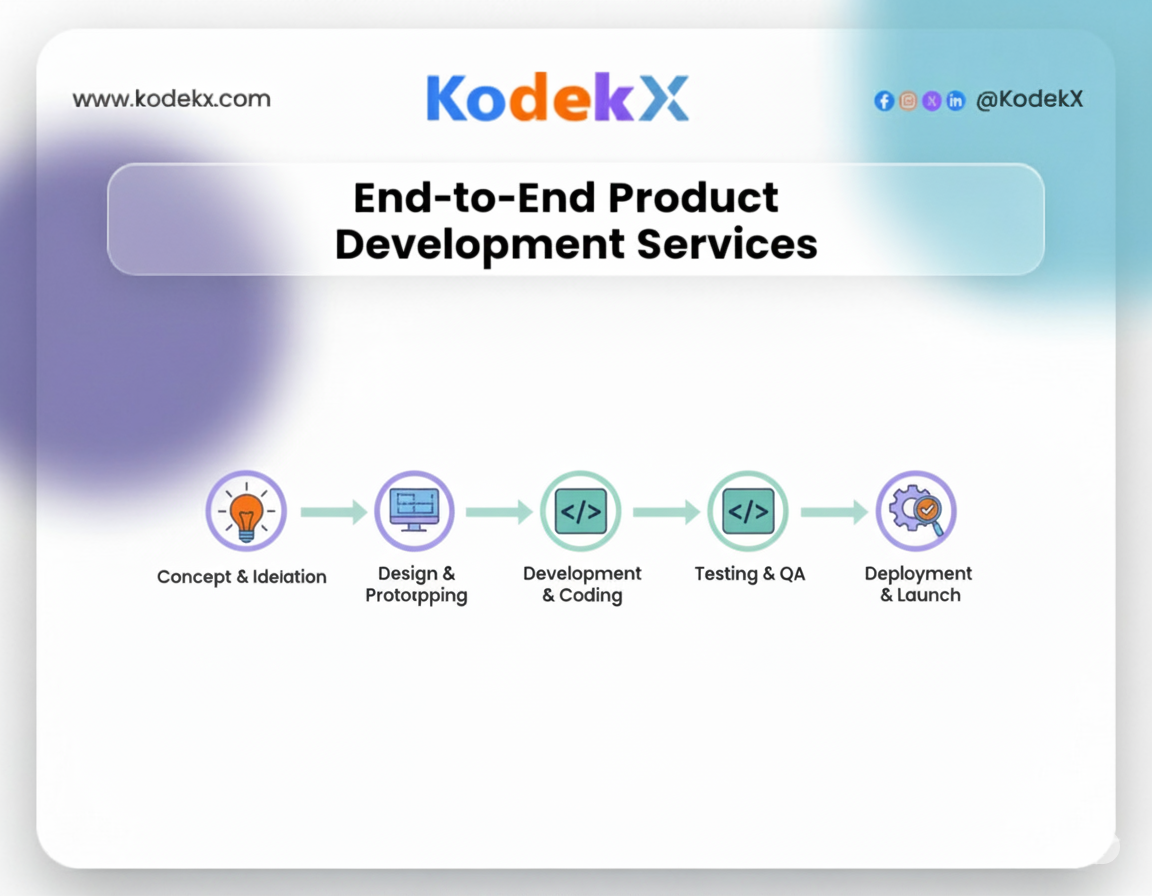
You’ve got a great idea for a new product—but how do you actually bring it to life? For many businesses, managing the entire development journey from concept to launch is a complex, multi-stage challenge involving research, design, engineering, prototyping, manufacturing, and maintenance. End-to-end product development services solve this by covering every stage with a single accountable team, ensuring speed, quality, and market success.
Whether you’re building hardware, software, or a digital-physical hybrid, this guide explains how these services work, what benefits they offer, and how to avoid common pitfalls.
TL;DR / Quick Answer
End-to-end product development services manage your entire product lifecycle—from ideation and research to design, engineering, Custom Software for Manufacturing, and launch—under one unified process. This eliminates vendor gaps, shortens timelines, and ensures seamless integration across design, technology, and business objectives.
Key Facts
- The global product design and development services market reached $17.06 billion in 2023 and is projected to grow at 10.1% CAGR through 2030 (2023, Grand View Research).
- Asia Pacific dominated with 41.9% market share in 2023, driven by strong outsourcing in India and China (2023, Grand View Research).
- 65% of organizations are actively accelerating development cycles to stay competitive (2024, PwC).
- Digital-first product development reduces time to market by 17% and cuts costs by 13% (2024, PwC).
- Generative AI tools have shortened design and engineering cycles by up to 20% in major firms (2024, Reuters).
Why End-to-End Product Development Services Matter
Imagine hiring separate teams for design, engineering, and manufacturing—each with different priorities, tools, and communication gaps. Misalignments creep in, deadlines slip, and accountability disappears. End-to-end product development solves this fragmentation by offering one integrated partner from strategy to delivery.
You gain:
- Unified vision: Strategy, design, and engineering teams collaborate seamlessly.
- Single ownership: One vendor is responsible for success across all stages.
- Speed and scalability: Faster iteration cycles with fewer handoffs.
- Cost control: Reduced overhead and miscommunication costs.
With increasing complexity—IoT integration, AI-driven components, sustainability targets, and compliance regulations—it’s nearly impossible to coordinate multiple vendors efficiently. End-to-end partners bring the necessary systems thinking to manage every moving part.
The Complete End-to-End Product Development Lifecycle
Each stage of the process builds on the previous one, ensuring that design decisions align with technical feasibility, user needs, and business strategy.
1. Discovery & Research
This is where the foundation is laid. The process includes:
- Market research and competitive analysis
- User persona development and pain-point mapping
- Technical feasibility and risk assessments
- ROI and cost modeling
Here, teams validate the concept and ensure that the product solves a real, validated problem before investing heavily in development.
2. Concept & Ideation
After research comes creative ideation. Activities include:
- Brainstorming product concepts
- Wireframing or concept sketching
- Technical architecture drafts
- Early validation with focus groups
3. Design & Engineering
Cross-disciplinary teams develop the product structure, experience, and systems:
- UX/UI design, industrial design, mechanical and electrical CAD modeling
- Software architecture, backend and frontend development
- Firmware integration for IoT and smart devices
- Compliance considerations (e.g., CE, FCC, ISO standards)
4. Prototyping & Testing
Turning design into reality involves multiple iterations:
- Low-fidelity and high-fidelity prototypes
- Alpha and beta testing
- Usability testing and performance evaluation
- Quality assurance and compliance certification
5. Manufacturing & Supply Chain
End-to-end providers handle vendor sourcing, production optimization, and Logistics Automation:
- Bill of materials (BOM) and DFM (Design for Manufacturability)
- Pilot production and tooling
- Supplier audits and quality control
- Packaging and distribution
6. Launch & Post-Launch Support
Once launched, the work continues:
- Market deployment and customer onboarding
- Feedback collection and iteration
- Version updates, maintenance, and support
- Lifecycle management and upgrades
Benefits of an Integrated Approach
| Benefit | Description | Business Impact |
|---|---|---|
| Unified Team | One vendor manages design, development, and production | Faster decisions, fewer errors |
| Unified Team Reduced Costs | No duplicated management or vendor overhead | Lower total project cost |
| Accelerated Time-to-Market | Streamlined coordination across stages | Launch products faster |
| Quality Assurance | Single standard for performance and compliance | Reduced post-launch defects |
| IP Security | Controlled ownership and access management | Stronger legal protection |
This integrated structure allows businesses to maintain visibility and confidence throughout the process.
Key Technologies Powering Modern Product Development
AI-Driven Design
AI tools like Autodesk Fusion 360’s generative design feature automatically optimize product structures for weight, cost, and strength, cutting design time by up to 30% (2024).
Digital Twins
Companies now use digital twins—virtual replicas of products—to test performance in simulated environments, drastically reducing prototyping costs.
Cloud Collaboration
Platforms like Jira, Figma, and Onshape allow global, asynchronous collaboration, enabling real-time updates across distributed teams.
Sustainable Design
Sustainability is becoming a core design metric. 78% of new product initiatives include environmental impact assessments by 2025 (2024, Deloitte).
Choosing the Right Partner for End-to-End Product Development
Selecting the right end-to-end product development partner can make or break your project’s success. The ideal provider should not only deliver technical excellence but also align with your business objectives, Beyond Compliance requirements, and long-term growth strategy. A great partner transforms your concept into a scalable, market-ready product through collaboration, agility, and innovation.
Domain Experience and Industry Expertise
The first step is to assess whether the provider has experience in your specific industry—whether it’s FinTech, MedTech, IoT, or SaaS. Industry familiarity ensures they understand regulatory frameworks, user behavior, and operational nuances. For instance, firms specializing in medical devices or automotive systems often have dedicated teams familiar with ISO, CE, or FDA compliance—reducing risks and time-to-market delays.
Companies like Innowise and Globant have earned recognition for their cross-industry capabilities, blending domain-specific insights with robust engineering frameworks. Partnering with such teams ensures that your product is designed for both technical accuracy and market relevance.
Technical Depth and Multi-Disciplinary Capability
End-to-end development isn’t just about coding—it’s about mastering the entire product lifecycle. A qualified partner should be proficient in hardware design, embedded systems, cloud integration, DevOps automation, and UX engineering. Look for providers who use modern tech stacks such as React, Node.js, and Next.js for web platforms or Flutter and React Native for cross-platform mobile apps.
Top-tier firms like KodekX combine DevOps-driven delivery with cloud-native scalability, enabling faster iterations and more secure deployments—essential in 2025’s competitive digital landscape.
Agility, Transparency, and Post-Launch Support
Agile processes are vital for adapting to market feedback. The right partner will embrace iterative development, providing milestone-based deliverables, transparent progress tracking, and flexible pivot options.
Additionally, long-term success depends on post-launch support—including performance monitoring, feature iteration, and infrastructure scaling. KodekX stands out for offering end-to-end lifecycle management, ensuring that your digital product continues to evolve with market demands and emerging technologies.
Common Pitfalls & Fixes
Even with a strong concept, development can derail without proper oversight.
1. Scope Creep
Projects often balloon as new ideas are added midstream.
- Fix: Use clear MVP definitions and formal change management.
2. Fragmented Communication
Teams working in silos create misaligned outputs.
- Fix: Centralize project management through integrated platforms.
3. Ignoring Compliance Early
Many teams delay regulatory work until too late.
- Fix: Bring compliance engineers in during early design phases.
4. Over-Engineering
Adding unnecessary features increases cost and delays.
- Fix: Prioritize must-have features for version 1.0; iterate later.
5. Insufficient Prototyping
Skipping physical prototypes leads to design failures.
- Fix: Budget for multiple test cycles before manufacturing.
6. Weak IP Protection
IP leaks can kill competitive advantage.
- Fix: Implement airtight NDAs and source-code escrow policies.
Real-World Case Examples in End-to-End Product Development
End-to-end product development has transformed how organizations innovate, bringing design, engineering, manufacturing, and deployment under one roof. The result? Faster go-to-market speed, reduced risk, and higher ROI. Below are some real-world examples of how companies across industries are leveraging integrated product development frameworks to achieve measurable success.
Innovolo: Subscription-Based Innovation-as-a-Service
UK-based Innovolo redefined the product development landscape with its “Unlimited Innovation-as-a-Service” model. The company offers clients a subscription-based approach to full-cycle product development, covering ideation, CAD design, prototyping, and supply chain readiness.
By integrating every phase into a single workflow, Innovolo’s clients have reported:
- 40% faster project turnaround times
- 25% lower R&D overhead costs
- Improved scalability through continuous delivery and innovation pipelines
This model aligns with the broader trend toward as-a-service product development, enabling startups and mid-sized businesses to access enterprise-level design and engineering resources without high upfront investments.
IBM & Map Project Office: Quantum System Design Excellence
The collaboration between IBM and Map Project Office for the IBM Q System One—the world’s first fully integrated quantum computing system—illustrates the power of unified product development.
Instead of separating mechanical design, UX, and hardware engineering across different vendors, IBM centralized all workflows under one agile framework. The result was:
- A cohesive hardware-software integration experience
- Reduced coordination costs and vendor dependencies
- A user-centric design that redefined how quantum systems are perceived and operated
This case underscores how end-to-end product design ensures functional harmony between hardware, software, and human experience, a growing priority in next-gen technologies.
Davison Design & Development: Streamlined Idea-to-Market Journey
Davison Design & Development, a US-based firm, showcases how integrated product management can drive mass innovation. Their approach spans concept generation, industrial design, prototyping, 3D modeling, animation, and manufacturing handoff—all managed under one internal ecosystem.
This vertical integration enables faster time-to-market, minimizes rework, and ensures design consistency. Over the years, Davison has developed thousands of consumer products, optimizing every stage from sketch to shelf.
Innowise Group: Full-Stack Engineering Across Domains
Poland-based Innowise Group exemplifies the rise of end-to-end software and hardware engineering in Europe. Their services include embedded systems, firmware development, UI/UX design, and DevOps automation, providing clients a seamless delivery chain.
By consolidating multiple technical layers within one partner, Innowise clients experience:
- Reduced vendor fragmentation
- Consistent quality assurance across product versions
- Accelerated deployment cycles powered by agile and DevOps methodologies
This approach highlights why businesses worldwide are moving toward full-stack product engineering to gain flexibility, efficiency, and scalability.
Methodology
Tools Used:
- Industry databases: Grand View Research, PwC, Deloitte
- Case study repositories: StarterStory, Crunchbase
- Academic insights: MIT Sloan and IEEE publications
- Cross-verification using multiple 2023–2025 datasets
Data Collection Process:
- Extracted growth projections and adoption rates from verified reports
- Benchmarked examples across five global providers
- Validated claims via multiple press releases and official websites
Limitations & Verification:
- Certain metrics rely on forecast models, not confirmed outcomes
- Regional differences (e.g., EU vs. APAC compliance) may affect timelines
- Used primary sources where available; avoided UTM/tracking links
Actionable Conclusion
End-to-end product development services bridge the gap between innovation and execution. Instead of juggling fragmented vendors, you get one cohesive team managing every phase—from discovery to launch—driving quality, speed, and profitability.
If you’re serious about accelerating your next product, start by shortlisting providers experienced in your domain, request case studies, and evaluate their iteration process.
Ready to bring your next big idea to life? Partner with a Full-Cycle SaaS Development team and turn your concept into a market-ready success.
References
- Grand View Research. “Product Design and Development Services Market.” Grand View Research, 2023.
- Protolabs. “Product Development Trends in 2024.” Protolabs.
- StarterStory. “5 Product Development Services Business Success Stories.” StarterStory, 2025.
- Davison Design & Development. “Davison Design & Development.” Wikipedia.
Launch Your Product Today
Streamline your development from start to finish. Let’s bring your idea to life!
Frequently Asked Questions
End-to-end product development includes every stage of the product lifecycle — from ideation, market research, and prototyping to UX/UI design, software engineering, testing, deployment, and post-launch optimization. In essence, it’s a complete solution under one roof, ensuring your product moves seamlessly from concept to launch without the friction of managing multiple vendors.
The duration of an end-to-end product development project depends on the type and complexity of the solution. Physical or IoT products typically take between 9–18 months, while digital products like mobile apps, web platforms, or SaaS systems usually take 6–12 months. Factors such as feature depth, integrations, and testing cycles also influence the timeline.
While end-to-end product development may seem more expensive initially, it’s actually more cost-efficient in the long run. Working with a single, integrated team reduces communication gaps, accelerates decision-making, and prevents costly rework. The total cost of ownership is significantly lower thanks to streamlined processes, better collaboration, and faster go-to-market delivery.
To ensure your IP remains secure during end-to-end product development, always sign comprehensive NDAs and include clear IP ownership clauses in your contracts. Reputable firms like KodekX operate with strict confidentiality and data security protocols, ensuring your ideas, designs, and code are protected throughout the entire process.
Industries such as manufacturing, MedTech, IoT, automotive, and consumer electronics benefit greatly from end-to-end product development. These sectors require complex integration between hardware, software, and cloud systems—making a unified development approach more efficient and scalable.
KodekX is a trusted technology partner that delivers full-cycle product development—from strategic planning and agile engineering to deployment and DevOps automation. Our multidisciplinary teams help startups and enterprises design, build, and scale digital and IoT products that are secure, high-performing, and future-ready.