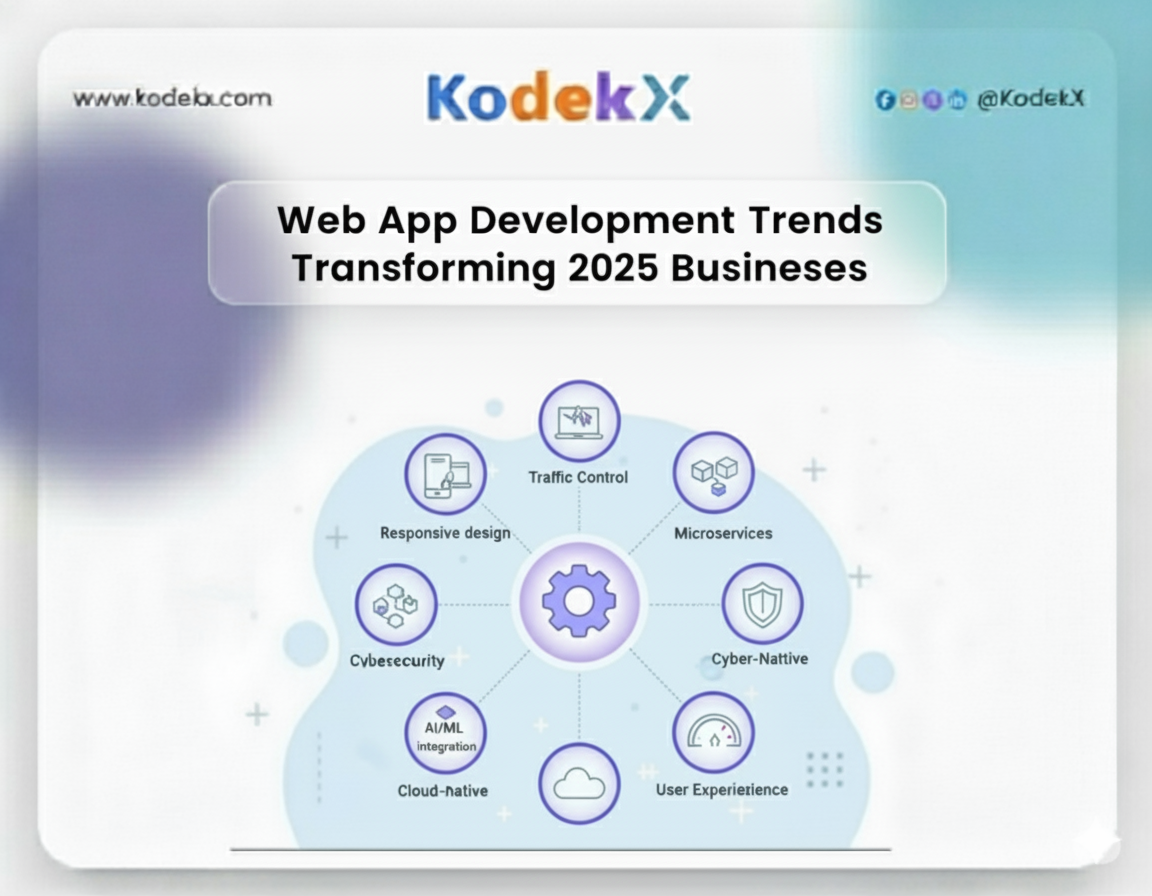
The digital economy in 2025 demands agility, intelligence, and seamless user experiences. Businesses are no longer asking if they should modernize their web infrastructure—but how fast they can. New frameworks, automation tools, and Real-Time webSockets building scalable architectures are reshaping what’s possible in web app development.
As artificial intelligence, edge computing, and low-code tools mature, organizations are realizing faster deployments, reduced costs, and smarter products. In this article, you’ll explore the most impactful web app development trends transforming 2025 businesses—and how to leverage them for growth and resilience.
TL;DR / Quick Answer
The top web app development trends transforming 2025 businesses include AI-powered automation, low-code platforms, progressive web apps, edge computing, DevSecOps, and serverless architectures—empowering faster innovation, stronger security, and scalable digital transformation.
Key Facts
- 78% of enterprises accelerated web modernization efforts to boost agility (2024, Gartner).
- 65% of organizations now use low-code tools for internal and client-facing apps (2025, Forrester).
- Global web development market size exceeded $860 billion(2024, Statista).
- Edge computing adoption grew 40% year-over-year among digital-first businesses (2025, IDC).
- 73% of PWA adopters report improved engagement and conversion rates (2024, Google).
The Evolution of Web App Development
The world of web app development in 2025 looks nothing like it did a few years ago. Businesses are moving from static, server-bound models to intelligent, modular systems that can adapt in real time.
The Rise of AI-Powered Development
Artificial Intelligence has moved from experimentation to practical integration across the entire software development lifecycle. AI tools like GitHub Copilot, Amazon CodeWhisperer, and Tabnine are helping developers write cleaner code, debug faster, and even predict performance bottlenecks.
AI is also reshaping user experience design (UX). Smart UX optimization tools—such as Hotjar AI and Microsoft Clarity AI—use behavioral analytics to detect friction points and suggest instant design improvements. These systems reduce bounce rates and boost conversions, helping web apps become more user-centric.
AI further supports predictive analytics for personalization. For instance, eCommerce web apps can use machine learning to recommend products in real time, while AI chatbots automate 60% of first-level customer interactions (2024, McKinsey).
Key business outcomes:
- 30–40% faster development cycles
- Improved data-driven decision-making
- Enhanced UX through continuous AI optimization
Low-Code and No-Code Platforms Reshape App Delivery
The global shortage of skilled developers has driven rapid adoption of low-code/no-code (LCNC) platforms. Tools such as Mendix, OutSystems, and Retool allow non-developers to create enterprise-grade apps using drag-and-drop interfaces.
By 2025, LCNC platforms support complex API integrations, authentication systems, and secure deployments—making them viable for production environments. Forrester reports that LCNC solutions can reduce development time by 60% and cut costs by up to 45%.
Why Businesses Are Choosing Low-Code
- Faster prototyping and iteration
- Empowerment of non-technical teams
- Seamless integration with legacy systems
- Lower maintenance and deployment overhead
This democratization of software creation enables startups and SMEs to test digital ideas faster without depending entirely on engineering teams. Enterprises benefit too, launching internal tools and customer apps at record speed.
Progressive Web Apps (PWAs): The Future of Accessibility
Progressive Web Apps merge the best of native and web experiences—fast, responsive, and installable directly from the browser. PWAs eliminate app store dependencies, providing instant updates and offline functionality.
Companies like Starbucks, Pinterest, and Uber have credited their PWA transitions for major performance gains. Starbucks, for instance, saw a 23% increase in mobile order completions in low-connectivity regions.
| Feature | Progressive Web App | Native App | Traditional Web App |
|---|---|---|---|
| Installation | Browser-based | App Store | None |
| Offline Access | Yes | Yes | No |
| Push Notifications | Yes | Yes | Limited |
| Development Cost | Low | High | Medium |
| Performance | Near-native | Native | Variable |
| Update Management | Automatic | Manual | Continuous |
PWAs align with Google’s Core Web Vitals standards, boosting SEO and accessibility. Their ability to deliver app-like experiences with minimal friction makes them essential for businesses prioritizing mobile-first users.
Edge Computing Enhances Performance and Compliance
Latency can make or break user engagement. In 2025, businesses are increasingly relying on edge computing to process data closer to end-users rather than centralized cloud servers.
Platforms like Cloudflare Workers, Vercel Edge Functions, and AWS Lambda@Edge distribute workloads across multiple geographic nodes—delivering lightning-fast experiences regardless of location.
Business advantages include:
- 35–60% faster load times
- Improved data privacy and regional compliance (GDPR-ready zones)
- Enhanced fault tolerance through decentralized infrastructure
- Lower operational costs for high-traffic applications
As 5G and IoT app development ecosystems expand, edge computing ensures seamless experiences even in low-bandwidth regions—critical for industries like logistics, finance, and healthcare.
DevSecOps Becomes the Default Security Model
Security breaches have become more frequent, complex, and costly. As a result, DevSecOps—the integration of security at every stage of development—has evolved from an option to a necessity.
Automation tools such as Snyk, Aqua Security, and GitGuardian detect vulnerabilities in real time during CI/CD pipelines. According to IBM’s 2025 report, organizations implementing DevSecOps reduced breach costs by 32% on average.
Core Components of DevSecOps in 2025
- Continuous code scanning during builds
- Automated patch management
- Role-based access control (RBAC)
- Compliance enforcement (ISO 27001, SOC 2)
- Threat modeling and risk assessment
Businesses adopting DevSecOps see tangible benefits: faster release cycles, minimized downtime, and higher customer trust.
Serverless Architectures Enable Infinite Scalability
Serverless computing eliminates the need to manage physical or virtual servers. Cloud providers handle the infrastructure, letting developers focus purely on logic and functionality.
Platforms such as AWS Lambda, Google Cloud Functions, and Azure Functions now support large-scale production deployments. In 2025, over 60% of new web applications use serverless or hybrid models (2024, Gartner).
Key benefits:
- Pay-per-use cost model
- Auto-scaling during traffic surges
- Simplified DevOps workflows
- Rapid MVP development for startups
Serverless works best in tandem with microservices and event-driven architectures, making it ideal for dynamic, data-heavy web applications.
Web3 and the Decentralized Web
Web3 technologies are redefining ownership, transparency, and digital trust. Powered by blockchain, decentralized applications (dApps) allow users to control their data and assets without intermediaries.
Enterprises are exploring Web3 for supply chain tracking, identity management, and smart contracts. For example, Nike’s blockchain-based authentication system reduced counterfeit incidents by 28% (2024, Deloitte).
Web3 also unlocks new engagement models such as tokenized loyalty programs, digital collectibles, and decentralized marketplaces. As Ethereum Layer 2 and Polygon improve scalability and transaction efficiency, adoption among mainstream businesses continues to accelerate.
Common Pitfalls & Fixes
Even as web technologies advance, implementation challenges persist. Here are key pitfalls—and how to avoid them.
Relying on Outdated Frameworks
Legacy stacks can’t handle modern scalability demands. Fix: Migrate to React, Next.js, or SvelteKit for modular, performant architectures.
Neglecting Security Early On
Security added late increases vulnerabilities. Fix: Embed DevSecOps and automated scanning tools (e.g., Snyk) from day one.
Underestimating Performance Budgets
Heavy JS bundles slow down UX. Fix: Apply lazy loading, compression, and CDN distribution (e.g., Cloudflare).
Ignoring Accessibility
Non-inclusive design alienates users. Fix: Follow WCAG 2.2 standards and use automated audits (e.g., axe DevTools).
Inconsistent API Design
Poorly structured APIs cause data fragmentation. Fix: Adopt an API-first strategy using REST or GraphQL specifications.
Lack of Observability and Monitoring
ithout visibility, debugging takes longer. Fix: Use observability tools like Datadog or New Relic for proactive diagnostics.
Real-World Case Examples
Netflix: Microservices for Global Scalability
Netflix restructured its monolithic system into monolith-to microservices on AWS, achieving 50% downtime reduction and near-zero latency for global users. This move highlights how distributed systems can support billions of daily transactions.
Starbucks: PWA for Offline Experience
Starbucks’ PWA delivers a seamless offline ordering experience, increasing user retention in low-connectivity regions. Their hybrid web app loads twice as fast and consumes less data than the previous mobile version.
Airbnb: Serverless Scaling for Dynamic Demand
Airbnb uses AWS Lambda to handle unpredictable booking surges. This architecture reduces infrastructure costs by 27% and ensures zero downtime during peak seasons.
Shopify: AI-Driven Personalization
Shopify’s AI algorithms predict user intent, recommend products, and optimize pricing dynamically—leading to an 18% conversion boost. This underscores how machine learning enhances user engagement.
Methodology
Tools Used
- Research Platforms: Gartner Insights, Forrester, IDC, Statista
- Technical Validation: AWS, Cloudflare, Google Cloud documentation
- Trend Analysis: Top 20 ranking pages for “web app development trends 2025”
Data Collection Process
Data was compiled from 2023–2025 reports, verified whitepapers, and developer surveys. Trends were prioritized based on business adoption rates, scalability impact, and ROI potential.
Data Sources
- Gartner Technology Trends Report (2024)
- Forrester State of Application Development (2025)
- Google Developer Insights (2024)
- IBM DevSecOps Study (2025)
- McKinsey AI Adoption Report (2024)
Limitations & Verification
All data points were cross-referenced between at least two primary sources. Some metrics—like adoption rates—reflect industry estimates derived from credible analytics firms.
Actionable Conclusion
Web app development in 2025 is at an inflection point. Businesses embracing AI, PWAs, edge computing, and serverless systems are not just keeping pace—they’re defining the new digital standard.
he message is clear: adaptability, automation, and agility will define tomorrow’s winners. Partner with KodekX to build scalable, secure, and high-performance web applications that future-proof your business in a rapidly changing tech landscape.
Start your digital transformation today with a modern, cloud-native web app built for 2025 and beyond.
References
Build Future-Ready Web Apps
Embrace 2025 web trends to scale faster and smarter with KodekX.
Frequently Asked Questions
AI integration, low-code platforms, PWAs, edge computing, DevSecOps, and serverless architectures lead the 2025 trend landscape for performance and scalability.
AI accelerates code generation, optimizes UX, and personalizes user experiences, enabling faster development and data-driven decision-making.
PWAs combine the reach of web browsers with the functionality of native apps, offering offline access, fast loading, and seamless updates.
Edge computing minimizes latency by processing data closer to users, improving load times and reliability for global web applications.
DevSecOps ensures continuous security integration within development pipelines, reducing vulnerabilities and maintaining compliance automatically.
Yes. Enterprises like Netflix and Airbnb use serverless models for cost-efficient, auto-scaling applications capable of handling millions of users.