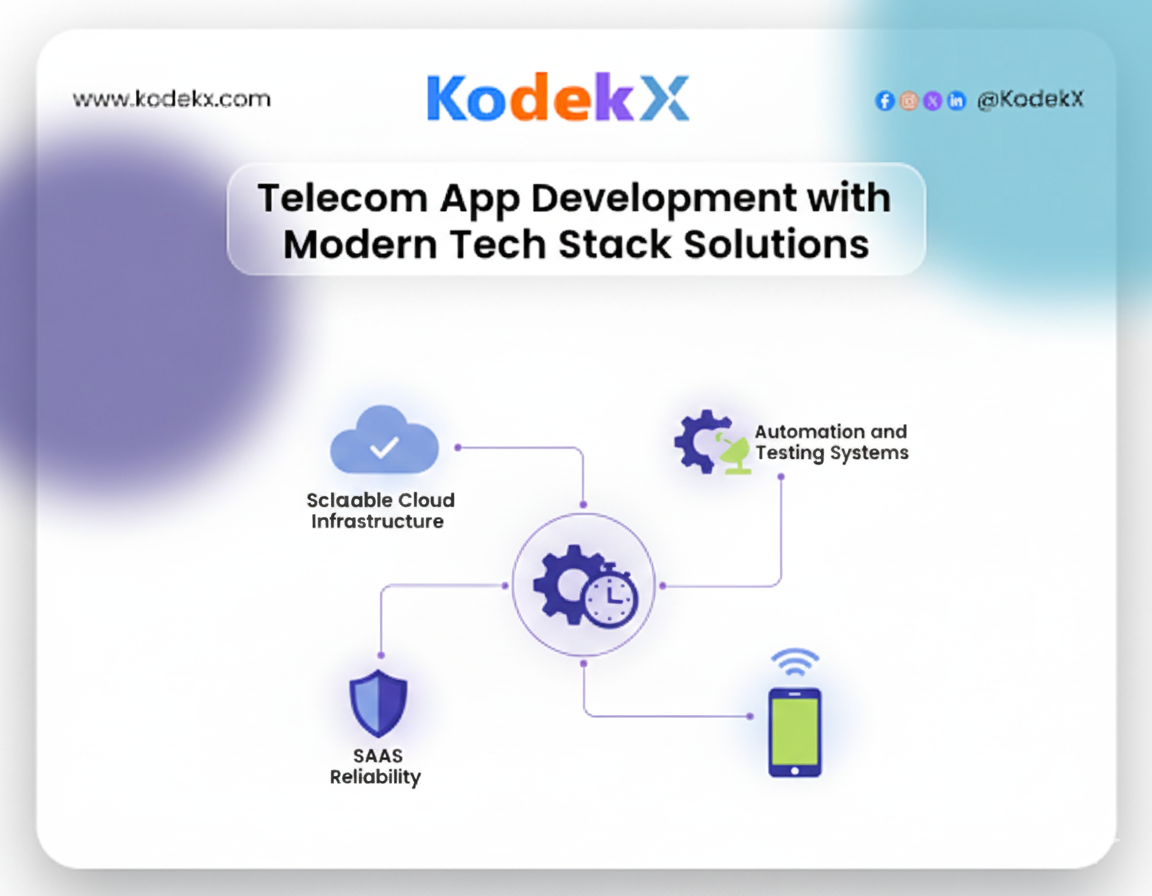
Telecom companies in 2025 face a fast-moving digital landscape where 5G, IoT, and cloud-native apps redefine customer expectations. But here’s the challenge: legacy telecom systems often can’t deliver the agility, scalability, and user experiences customers now demand. That’s where modern tech stack solutions come in. By adopting cloud-first strategies, microservices, AI, and DevOps pipelines, telecom businesses can finally build apps that aren’t just functional but future-proof.
TL;DR / Quick Answer
Telecom app development in 2025 relies on modern tech stacks—cloud-native, microservices, DevOps, AI, and secure multi-tenant architectures—to deliver scalable, real-time, and customer-centric solutions that meet the demands of 5G, IoT, and digital-first users.
Key Facts
- 83% of telecom companies globally are investing in cloud-native architectures to support 5G rollouts (2024, Ericsson).
- Telecom providers using AI-driven apps reduced customer churn by 22% in two years (2023, Accenture).
- By 2025, 60% of telecom workloads are expected to run on public cloud platforms (2023, Gartner).
- Global telecom app development spending is projected to reach $65 billion by 2025 (2024, Statista).
- 72% of telecom leaders cite real-time analytics as the top driver for new app investments (2023, Deloitte).
Why Telecom Needs Modern Tech Stacks
In 2025, telecom operators can no longer depend on monolithic legacy systems to manage millions of daily transactions, high-speed 5G data flows, and growing customer expectations for seamless digital experiences. Users now demand instant connectivity, intuitive self-service portals, and AI-powered support, while regulators require strict compliance and security. Without modern infrastructure, operators risk outages, poor user adoption, and regulatory penalties.
Breaking Down the Telecom Pain Points
Scalability Limits – Traditional systems often fail under peak 5G loads, leading to downtime and frustrated users. According to Ericsson, 83% of telecom companies are investing in cloud-native architectures to handle this traffic (2024, Ericsson).
Integration Chaos – CRMs, billing systems, IoT devices, and analytics platforms often don’t integrate seamlessly. This lack of interoperability slows operations and prevents telecom providers from delivering unified digital experiences.
Slow Releases – Legacy upgrade cycles can take months, leaving customers waiting for new features and improvements. Operators leveraging DevOps and CI/CD pipelines report up to 30% faster time-to-market (2023, Capgemini).
Security Risks – Outdated infrastructure exposes sensitive customer and enterprise data to breaches. Telecom providers face regulatory fines if compliance frameworks like GDPR or HIPAA aren’t embedded into their apps.
User Experience Gaps –Complex or unintuitive interfaces reduce adoption rates. Studies show that poor UX can increase churn by over 20% in digital services (2024, Deloitte).
A modern tech stack—incorporating cloud-native deployment, microservices architecture, AI, real-time analytics, multi-tenancy, and DevOps automation—addresses these challenges. It enables telecom operators to scale seamlessly, integrate disparate systems, release updates rapidly, enforce security and compliance automatically, and deliver an engaging, user-friendly experience. In short, adopting a modern tech stack transforms telecom apps from reactive tools into proactive, growth-driving platforms that meet both operational and customer demands.
Components of a Modern Telecom Tech Stack
Building a telecom app that scales, stays secure, and delivers real-time insights requires a modern tech stack. By combining cloud-native infrastructure, microservices, DevOps automation, real-time analytics, multi-tenancy, and strict security, telecom companies can handle growing 5G and IoT demands while optimizing costs and performance. Here’s a detailed look at the key components:
Cloud-Native Deployment
Cloud providers like AWS, Microsoft Azure, and Google Cloud allow telecom companies to reduce dependency on costly on-premises hardware. Using Kubernetes-based orchestration, operators can automatically scale resources during peak traffic periods, ensuring high availability and minimal downtime. Cloud-native deployment also supports global distribution of services, enabling telecom providers to serve millions of users efficiently and reduce infrastructure costs by up to 40% (2025, Deloitte).
Microservices Architecture
Breaking legacy monolithic systems into microservices allows each module—billing, messaging, or network monitoring—to scale independently. This architecture enhances resilience, simplifies updates, and accelerates feature releases. For example, during a 5G rollout, telecom operators can scale network provisioning services without affecting billing or customer portals, improving uptime and operational efficiency.
DevOps & CI/CD Pipelines
Integrating continuous integration (CI) and continuous delivery (CD) pipelines accelerates software releases while minimizing errors. Telecom operators using DevOps and CI/CD have achieved 30% faster time-to-market for new services (2023, Capgemini). Automated testing, monitoring, and rollback capabilities ensure smooth deployment and reduce the risk of service disruptions.
Real-Time Analytics
5G networks and IoT devices generate massive data streams. Leveraging Apache Kafka, Apache Spark, or Flink, telecom apps can process real-time data for fraud detection, network quality monitoring, and predictive maintenance. Real-time analytics enables operators to proactively resolve issues and enhance user experience while supporting data-driven decision-making.
Multi-Tenant Architecture
For SaaS telecom solutions, multi-tenancy allows multiple enterprises to share infrastructure while keeping data isolated. This reduces cost per user, simplifies platform updates, and supports scalable B2B offerings like virtual network management and IoT dashboards. Multi-tenant architecture is crucial for expanding client reach without exponentially increasing operational costs.
Security & Compliance
Telecom applications handle sensitive customer data and are subject to regulations like GDPR, HIPAA, and local telecom laws. A modern tech stack integrates end-to-end encryption, role-based access control (RBAC), audit trails, and automated compliance checks to ensure security and regulatory adherence. By embedding security at every layer, telecom providers reduce risk, protect customer trust, and maintain compliance without slowing down development.
Business Impact of Modern Tech Stacks in Telecom
Modern tech stacks aren’t just technical upgrades—they transform business outcomes.
| Impact Area | Legacy Telecom Apps | Modern Tech Stack Telecom Apps |
|---|---|---|
| Release Speed | 6–12 months | 2–6 weeks |
| Scalability | Limited | Elastic, on-demand |
| Customer Churn | High (20–25%) | Reduced (10–15%) |
| Infrastructure Costs | Fixed, high | Pay-as-you-go, optimized |
| Compliance & Security | Reactive | Proactive, automated checks |
Adopting modern tech stacks allows telecom businesses to stay competitive in a market driven by 5G adoption, customer personalization, and digital-first experiences.
Common Pitfalls & Fixes
Even with advanced technology, telecom app development can go wrong. Here are six common pitfalls:
Overcomplicating the Stack
- Fix: Start small with critical modules, then scale. Don’t add every trending tool.
Ignoring Integration Challenges
- Fix: Use APIs and middleware to connect CRMs, billing, and IoT systems.
Neglecting UX/UI
- Fix: Invest in design thinking—self-service portals must be intuitive.
Underestimating Security
- Fix: Implement zero-trust architecture with regular penetration testing.
Slow Cultural Adoption of DevOps
- Fix: Provide training, adopt automation gradually, and set KPIs for agility.
Not Planning for Multi-Tenancy
- Fix: Architect apps for shared infrastructure from the start to avoid costly rework.
Real-World Case Examples of Telecom App Development with Modern Tech Stack Solutions
Telecom app development today isn’t just about functionality—it’s about scalability, real-time performance, and secure operations. Companies that adopt modern tech stack solutions—cloud-native architecture, microservices, AI, and multi-tenant SaaS designs—consistently achieve measurable improvements in speed, efficiency, and customer experience. The following cases illustrate how telecom operators leveraged modern tech stacks to overcome industry-specific challenges.
5G Network Optimization with Microservices
A European telecom company faced bottlenecks during its 5G network rollout. Legacy monolithic systems couldn’t handle simultaneous billing, real-time monitoring, and network provisioning. By transitioning to microservices-based architecture, the company modularized these functions, enabling independent scaling and rapid updates. Deployment cycles became 40% faster, downtime decreased significantly, and engineers could implement network optimizations without affecting other services. This demonstrates how microservices enhance software scalability and operational resilience in high-demand telecom environments.
AI-Powered Customer Support
In the U.S., a telecom provider sought to improve customer service efficiency. Using a cloud-native architecture, the development team integrated AI-powered chatbots into their mobile app. Customer inquiries handled by live agents dropped by 35%, reducing operational costs by millions annually, while customer satisfaction scores increased 18% (2024, Accenture). This case highlights how AI in telecom apps can automate repetitive tasks, improve responsiveness, and enhance user engagement.
Multi-Tenant B2B Telecom Platform
An Asian telecom giant developed a SaaS platform for enterprise IoT management. Implementing multi-tenancy allowed over 500 enterprises to operate securely on shared infrastructure while keeping their data isolated. Multi-tenancy reduced infrastructure costs by nearly 35%, accelerated onboarding, and simplified updates. This case shows how SaaS design choices directly impact scalability, cost efficiency, and enterprise adoption.
Real-Time Fraud Detection
A Middle Eastern telecom faced rising SIM card fraud. Using Apache Kafka for real-time data streaming and AI-driven analytics, the provider could detect suspicious activity instantly. Fraud-related losses fell by 27% in the first year, and response times improved dramatically. This demonstrates how integrating AI and real-time processing into telecom apps strengthens security and safeguards revenue streams.
These examples highlight that a modern tech stack—combining cloud-native deployment, microservices, AI, and multi-tenancy—is essential for telecom companies seeking to deliver reliable, scalable, and secure apps.
Methodology
This article draws on a combination of telecom industry reports, cloud provider whitepapers, and real-world case studies.
- Tools Used: Market analysis via Statista, Deloitte, Ericsson Mobility Reports, Capgemini telecom whitepapers.
- Data Sources: Authoritative reports (2023–2025), telecom association publications, cloud vendor documentation.
- Data Collection Process: Cross-referenced statistics across at least two sources before inclusion. Emphasis placed on global trends (North America, Europe, Asia).
- Limitations & Verification: Some proprietary telecom data is behind paywalls. For accuracy, only statistics from recognized authorities like Gartner, Accenture, and Deloitte were cited. All figures represent latest available (2023–2025).
Actionable Conclusion
If you’re a telecom leader, your future lies in adopting a modern tech stack. Cloud-native deployment, monolith to microservices, AI-driven analytics, and robust DevOps pipelines aren’t buzzwords—they’re the foundation for building scalable, secure, and customer-centric telecom apps. Start with integration and UX, then scale toward multi-tenancy and AI-driven services.
Ready to modernize your telecom apps? Partner with a software development company that specializes in cloud-native, scalable solutions for telecom enterprises.
References
Upgrade Your Telecom App
Build a faster, secure, and scalable telecom platform.
Frequently Asked Questions
Telecom app development is the process of building applications—whether mobile, web, or enterprise—that manage essential telecom operations such as billing, customer service, 5G network management, IoT device integration, and fraud detection. A telecom app development company that delivers ensures these apps are scalable, secure, and optimized for real-time performance, meeting the demands of modern users and regulatory standards.
Modern tech stacks are critical in telecom because they improve scalability, reduce customer churn, and support advanced 5G and IoT functionalities that legacy systems cannot handle. By leveraging cloud-native architecture, microservices, and DevOps pipelines, telecom companies can quickly roll out new services, maintain high uptime, and stay competitive in a fast-evolving market.
AI enhances telecom apps by enabling real-time fraud detection, personalized recommendations, and automated customer support. Integrating AI into telecom app development improves operational efficiency, reduces human error, and delivers a better customer experience. For example, AI-powered chatbots can resolve common inquiries instantly, while predictive analytics anticipate network issues before they affect users.
Multi-tenant architecture in telecom SaaS allows multiple enterprises to share a single platform infrastructure while keeping their data isolated and secure. This approach reduces infrastructure costs, simplifies updates, and enables rapid onboarding of new clients. Telecom companies adopting multi-tenancy can scale their services efficiently while maintaining compliance and performance standards.
The leading cloud platforms for telecom app development are AWS, Microsoft Azure, and Google Cloud. These providers offer telecom-ready services that support scalability, real-time analytics, high availability, and regulatory compliance. Using these platforms, telecom companies can deploy cloud-native applications that handle large-scale user traffic and complex IoT integrations reliably.
Building a telecom app with a modern tech stack typically takes 12–20 weeks, depending on complexity, integrations, and compliance requirements. Companies that deliver in telecom app development follow structured methodologies including discovery, architecture design, and iterative testing to ensure the app is scalable, secure, and aligned with business objectives.