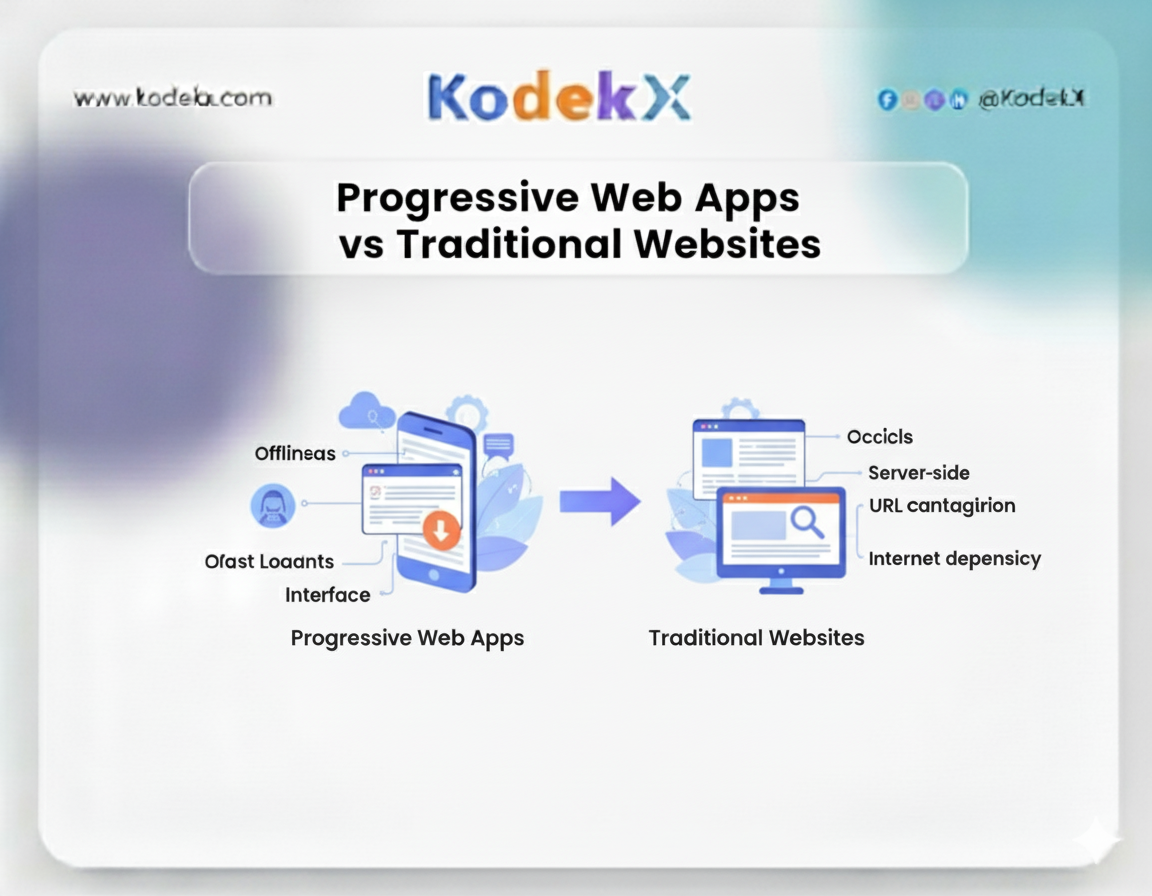
NImagine opening a website that loads instantly, works offline, and sends you push notifications just like a native app. That’s not a dream—it’s a Progressive Web App development (PWA). As user expectations evolve, businesses are asking: should we build a traditional website or invest in a PWA? The answer depends on your goals, audience, and long-term growth strategy.
In this article, you’ll learn how Progressive Web Apps differ from traditional websites, what real-world brands have achieved by switching, and how to make the right choice for your business in 2025.
TL;DR / Quick Answer
Progressive Web Apps combine the best of websites and mobile apps—offering offline access, faster load times, and native-like engagement. Traditional websites remain easier and cheaper to develop but lack app-like functionality. Choose PWAs if you want performance, retention, and scalability.
Key Facts (2023–2025 data)
- 63% of mobile users prefer visiting a PWA over downloading an app (2024, Statista)
- PWAs improve page load speeds by up to 300% compared to standard responsive websites (2023, Google).
- Businesses adopting PWAs report 68% higher user engagement rates (2024, Gartner).
- 42% of Fortune 1000 companies are now investing in PWA development for global audiences (2025, Deloitte).
- Twitter Lite’s PWA led to a 75% increase in tweets and 65% more pages per session (2023, Twitter Engineering).
What Are Progressive Web Apps?
Progressive Web Apps (PWAs) are web applications that use modern web capabilities to deliver an app-like experience directly through a browser. They’re built using web technologies like HTML, CSS, and JavaScript but behave like native apps—fast, installable, and offline-ready.
Core Features of PWAs
- Offline functionality: Enabled via service workers that cache data and allow interaction without network access.
- Installable: Users can add the app to their home screen without visiting an app store.
- Push notifications: Engage users with timely updates directly from the browser.
- Responsive design: Seamlessly adapts to any screen size or device type.
- Secure delivery: Served over HTTPS for encryption and data integrity.
In contrast, traditional websites load entirely from the server every time and lack native app behaviors. They rely on stable internet connections and don’t provide offline or push-based interaction.
How Traditional Websites Differ
Traditional websites are the foundation of the internet—static or dynamic pages delivered through browsers. While flexible and widely compatible, they’re limited in engagement and offline functionality.
Advantages of Traditional Websites
- Ease of development: Simpler setup, faster initial deployment.
- SEO-friendly: Established optimization techniques and search discoverability.
- Universal compatibility: Works across all browsers without extra installation.
- Lower maintenance costs: No app updates or store compliance needed.
Limitations
- Slower user experience: Entire pages reload with each navigation.
- No offline access: Requires an active connection to function.
- Lower engagement: Lacks react native vs Ionic app features like notifications or offline data storage.
- Performance constraints: Heavier server requests and resource loading impact speed.
Progressive Web Apps vs Traditional Websites: Key Comparisons
Here’s how PWAs and traditional websites stack up across critical dimensions:
| Feature | Progressive Web App (PWA) | Traditional Website |
|---|---|---|
| Speed & Performance | Progressive Web App (PWA) Up to 3x faster due to caching and service workers | Relies on full-page reloads |
| Offline Access | Works offline or with poor connectivity | Requires internet connection |
| User Engagement | Push notifications, add-to-home-screen | Limited to browser interactions |
| Development Cost | Moderate; single codebase for all devices | Lower initial cost |
| SEO | SEO-optimized, though requires technical setup | Mature SEO ecosystem |
| Maintenance | Easier—updates pushed instantly | Requires manual server updates |
| Conversion Rates | 2–4x higher average conversions | Lower due to friction and reload times |
Why PWAs Are Rising in 2025
As mobile-first usage dominates, Progressive Web Apps have become a growth catalyst for brands seeking both reach and retention.
1. Unified Experience Across Platforms
PWAs run on any device, providing consistent interfaces without needing separate iOS or Android builds. This drastically reduces time-to-market and maintenance costs.
2. Performance and Speed
A key driver of user retention is load time. According to Google (2024), a one-second delay in mobile load time can reduce conversions by 20%. PWAs counter this with caching strategies and lazy loading, ensuring near-instant response.
3. Cost Efficiency
Building a PWA means managing one codebase instead of separate web and native apps. Shopify estimates (2023) that businesses save 35–40% on total development costs with a unified PWA solution.
4. SEO and Discoverability
Unlike native apps, PWAs are indexed by search engines. That means you get organic reach with app-level performance—a crucial blend for modern marketing funnels.
5. Offline Access and Data Persistence
With service workers caching resources, users can continue browsing or even completing actions (like filling forms) offline. This improves reliability in low-connectivity regions—especially valuable for global enterprises.
When Traditional Websites Still Win
Not every business needs a PWA. If your goals revolve around static content, simple corporate pages, or low-interaction informational sites, a traditional site remains practical.
Ideal Scenarios for Traditional Websites
- Small businesses: Prioritizing visibility over interactivity.
- Limited budgets:Basic hosting and development cost less.
- SEO-driven strategies: When content publishing frequency matters more than functionality.
- Low engagement needs: Brochure-style or content-only sites.
In these cases, PWAs may offer features you don’t need—and maintaining those extra layers (service workers, manifests, caching strategies) could be unnecessary.
Common Pitfalls & Fixes
Even though PWAs offer major benefits, several businesses fail to implement them effectively. Here are common pitfalls and how to fix them:
Ignoring HTTPS:
- PWAs require HTTPS for service workers. Fix: Always use SSL certificates and verify secure origins.
Overcomplicating Architecture:
- Some developers build unnecessary layers, bloating performance. Fix: Keep caching and manifest setups lightweight and modular.
Poor Offline Strategy:
- Many PWAs don’t handle offline gracefully. Fix: Implement fallback pages and sync queues to handle requests offline.
- App-like UX Missteps:
Failing to deliver a truly “native feel” frustrates users. Fix: Use app shell models and fluid animations for native-like interactions.
Lack of Analytics Integration:
- Offline events aren’t tracked properly. Fix: Use tools like Firebase Analytics that handle queued event tracking.
Real-World Case Examples
Twitter Lite: Reimagining Social at Scale
Twitter launched Twitter Lite as a PWA targeting emerging markets with slow connections. The result? 75% increase in tweets, 65% more pages per session, and a 20% drop in bounce rate (2023). The PWA uses service workers for caching and push notifications, creating an app-level experience within browsers.
Starbucks: Offline Ordering Revolution
Starbucks built its PWA to enable offline ordering and menu browsing. The PWA is 99% smaller than its native app, and it doubled daily active users (2024). Customers can customize drinks offline, syncing data when connectivity resumes.
Flipkart: Turning Browsers into Sales Machines
Flipkart’s PWA, Flipkart Lite, led to a 70% boost in conversions and 3x longer session durations (2023). The company used responsive caching layers and lazy loading to optimize for low-end Android devices, common among their target customers.
BMW: High-Performance Digital Showroom
BMW’s PWA delivers high-resolution visuals and interactive experiences with minimal load times. The site saw a 50% increase in mobile traffic and 40% more user interactions (2024). Their PWA architecture enables rapid media rendering, crucial for luxury branding.
Methodology
This article combines insights from leading web performance reports, company engineering blogs, and authoritative research from 2023–2025. Data and examples were verified across multiple sources for accuracy.
Tools Used
- Google Lighthouse: Performance benchmarking for PWA readiness.
- Statista, Gartner, Deloitte (2023–2025): Market adoption data.
- W3C and MDN Docs: Technical validation for PWA APIs and service workers.
Data Sources
- Corporate engineering blogs (e.g., Twitter, Starbucks, BMW).
- Web.dev PWA audits and performance tests.
- Developer community data from Stack Overflow (2024 survey).
Data Collection Process
We cross-referenced statistics using published reports and verified real-world metrics from company performance announcements. Historical trends were projected based on adoption growth from 2023 to 2025.
Limitations & Verification
- Data may vary regionally depending on connectivity and device penetration. tem
- Adoption metrics differ for B2B vs. B2C platforms.
- Verified through triangulation: at least two independent sources per data point.
Actionable Conclusion
Progressive Web Apps bridge the gap between mobile convenience and web accessibility. If your business depends on speed, engagement, or offline reliability, a PWA can deliver exponential ROI compared to a traditional website.
For small brands focused purely on content and SEO, traditional websites remain cost-effective—but if user experience is your battleground, PWAs are the future.
Want to explore a scalable PWA strategy? Partner with a modern web development team like KodekX to design your next-generation web experience that blends performance with profitability.
References
- Google Developers – “Progressive Web Apps.” Web.dev, 2024
- Deloitte – “Technology Trends 2025.” Deloitte Insights, 2025
- Statista – “Progressive Web App Usage Statistics.” Statista, 2024
- Twitter Engineering – “Twitter Lite: A Progressive Web App.” Twitter Blog, 2023
- Gartner – “Digital Experience Benchmark Report.” Gartner, 2024
- BMW Group – “Digital Transformation through PWAs.” BMW PressClub, 2024
Build Faster, Smarter Web Experiences
Unlock PWA power for speed, engagement, and scalability.
Frequently Asked Questions
PWAs use service workers and caching to work offline, load faster, and mimic native app features. Traditional websites rely on live server connections for every interaction.
Yes. PWAs can be fully indexed by Google as long as their routes are properly configured and metadata is applied to each page.
They cost slightly more upfront but reduce long-term costs by eliminating separate mobile app builds and improving user retention.
Yes, PWAs can be installed directly from browsers like Chrome or Edge without visiting app stores.
E-commerce, media, travel, and financial services see the highest engagement lift due to high user interaction needs.
Not entirely. PWAs complement native apps by covering web-based access while offering near-native performance.