Cloud computing has become the digital nervous system of modern enterprises — and in 2025, the debate between multi-cloud and hybrid cloud strategies is shaping how organizations architect resilience, control costs, and ensure sovereignty. You’ve likely heard these terms interchangeably, but the truth is, their operational and strategic impacts couldn’t be more different. Whether you’re a CTO's framework for cutting Costs managing complex workloads or a founder planning scalability, your cloud strategy defines your organization’s agility for the decade ahead.
TL;DR / Quick Answer
A multi-cloud strategy uses multiple public cloud providers (e.g., AWS + Azure + Google Cloud) for flexibility and redundancy, while a hybrid cloud strategy integrates public and private clouds for control and compliance. In 2025, most enterprises combine both, balancing cost, security, and scalability.
Key Facts
- 78% of enterprises now operate in hybrid or multi-cloud environments (2024, Flexera).
- 52% of organizations cite cost optimization as the main driver for multi-cloud adoption (2024, Gartner).
- The global hybrid cloud market is expected to reach $262 billion by 2025 (2024, IDC).
- Companies using both strategies report 30% faster deployment cycles (2024, IBM).
- 67% of IT leaders say data sovereignty drives hybrid architecture decisions (2024, Deloitte).
Understanding the Difference: Multi-Cloud vs Hybrid Cloud
Let’s start by clearing up confusion.
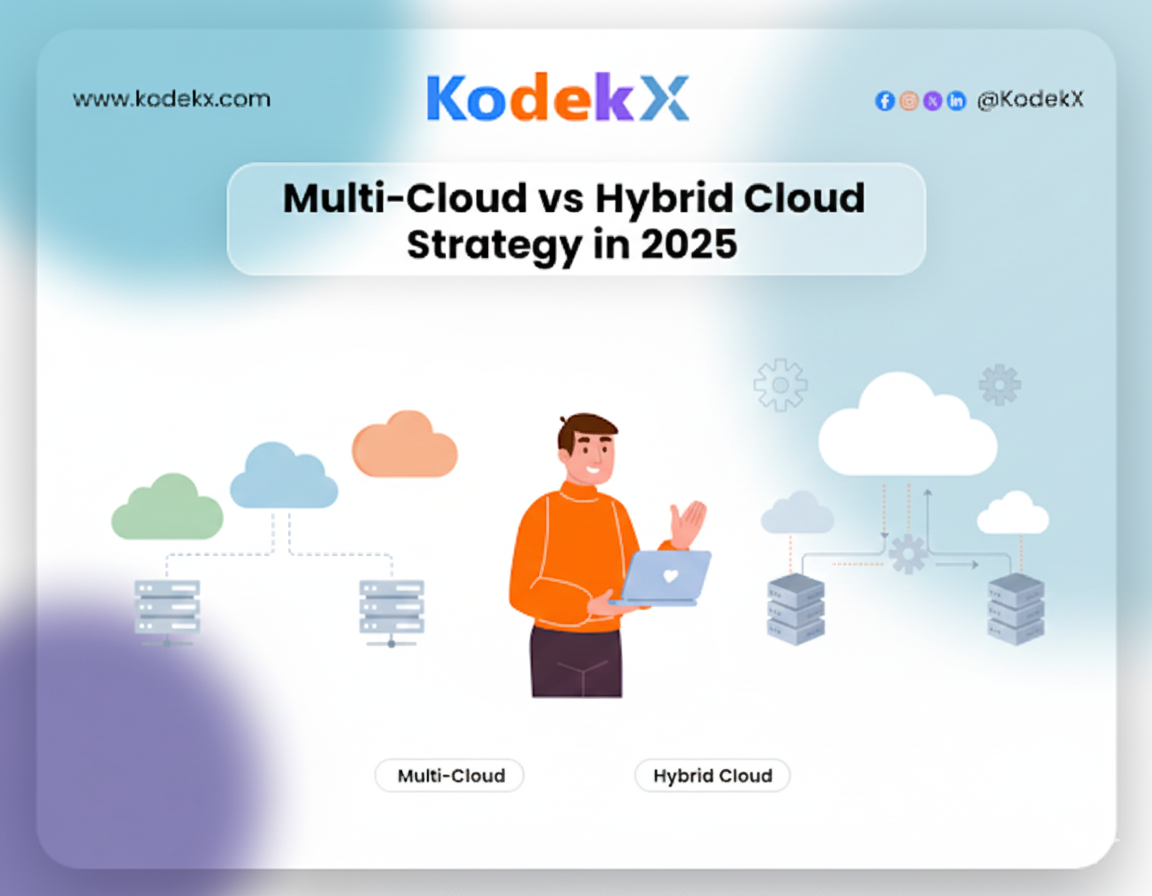
A multi-cloud strategy involves using multiple public cloud platforms from different providers. The goal? Avoid vendor lock-in and leverage the best tools from each ecosystem. For instance, a company may use AWS for AI, Azure for analytics, and Google Cloud for ML workloads.
NewA hybrid cloud strategy, on the other hand, blends private cloud or on-premises infrastructure with one or more public clouds. It’s ideal for industries like finance, healthcare, and government where data control, compliance, and security are critical.
| Strategy Type | Core Architecture | Ideal For | Key Benefits | Example Use Case |
|---|---|---|---|---|
| Multi-Cloud | Multiple public clouds | Scalability, innovation | Flexibility, vendor diversification | AWS + GCP combo for different workloads |
| Hybrid Cloud | Public + Private integration | Regulated industries | Compliance, control | On-prem data + Azure public workloads |
In short: multi-cloud maximizes flexibility, while hybrid cloud optimizes governance.
The Rise of Multi-Cloud Strategies in 2025
By 2025, the multi-cloud model is no longer experimental — it’s mainstream. Gartner reports that over 70% of enterprises now operate workloads across more than one public cloud provider. This rise is driven by three major factors:
- Vendor Diversification: Businesses can negotiate better pricing and reduce dependency on a single vendor.
- Innovation Access: Each cloud provider offers unique strengths — Google for AI/ML, AWS for scalability, Azure for enterprise integration.
- Performance Optimization:Workloads can be distributed regionally for reduced latency and disaster recovery resilience.
However, managing multiple platforms introduces challenges in security governance, cost visibility, and skill fragmentation. Leading companies now deploy Cloud Management Platforms (CMPs) like VMware Aria, Flexera Cloud Management, and HashiCorp Terraform to centralize control.
The Hybrid Cloud Advantage: Control and Compliance
Hybrid cloud shines when data sensitivity and compliance are top priorities. For example, a software Is transforming healthcare, finTech, and logistics provider may keep patient data on private infrastructure while processing analytics on a public cloud.
The key benefits include:
- Data Sovereignty: Keep critical data within local or private environments.
- Regulatory Compliance: Meet GDPR, HIPAA, and financial data protection standards.
- Seamless Scalability: Public cloud serves as an elastic extension of private systems.
- Security Layering: Sensitive operations remain isolated, while scalable workloads live on public clouds.
As of 2025, 62% of enterprises cite compliance mandates as their top reason for adopting hybrid cloud (IBM, 2024).
When Multi-Cloud Outperforms Hybrid Cloud
In 2025, multi-cloud architecture is proving to be the most agile and innovation-driven strategy for enterprises and startups alike. As organizations evolve toward composable digital ecosystems, they are leveraging multiple public cloud providers — AWS, Azure, and Google Cloud — to gain a competitive edge in scalability, resilience, and cost efficiency.
Imagine a SaaS startup building a data-driven product. It might use AWS Lambda for its serverless backend, Google BigQuery for large-scale analytics, and Azure Cognitive Services for machine learning inference. This approach empowers teams to choose the best-of-breed cloud service for each workload — no vendor lock-in, maximum flexibility.
Top Scenarios Where Multi-Cloud Excels
- AI-Driven Workloads Needing Specialized GPU Access:
With AI development accelerating, organizations often prefer multi-cloud setups to access NVIDIA H100 or AMD MI300 GPUs available on different clouds.
- Global SaaS Platforms Requiring Regional Redundancy:
Multi-cloud ensures compliance with data sovereignty laws by distributing workloads across regions.
- Enterprises Targeting 99.999% Uptime:
Redundancy across multiple clouds guarantees business continuity even if one provider experiences downtime.
- Cost Arbitrage and Dynamic Optimization:
Real-time workload shifting to lower-cost cloud regions or providers enables up to 30% cost savings, according to Gartner’s 2025 Cloud Economics Report.
Why Multi-Cloud is a Strategic Advantage
Multi-cloud supports vendor diversification, agile scaling, and rapid experimentation — critical in a world where time-to-market defines success. Organizations in industries like fintech, retail, and healthcare leverage this model to accelerate digital transformation while mitigating single-vendor dependency risks.
When Hybrid Cloud Wins the Game
While multi-cloud dominates agility, hybrid cloud excels in environments where data security, compliance, and legacy modernization intersect.
Consider a global bank: it cannot host sensitive transaction data in a public cloud due to regulatory constraints but can use the cloud for AI-based fraud detection or data visualization.
Ideal Use Cases for Hybrid Cloud
- Financial Institutions with Data Residency Requirements:
Hybrid environments allow critical data to remain on-prem while leveraging cloud-based analytics tools.
- Manufacturers Integrating IoT and Edge Computing:
Hybrid setups enable real-time data capture at the edge and analytics in the cloud for predictive maintenance.
- Public Sector and Healthcare:
Governments and hospitals use hybrid models to ensure data sovereignty and citizen privacy compliance.
- Enterprises Modernizing Legacy Infrastructure:
Hybrid cloud allows gradual migration without disrupting existing systems — reducing transformation risks by up to 40%, as per IBM’s 2024 modernization survey.
The Balance of Control and Agility
Hybrid cloud provides a bridge between the control of private systems and the scalability of public clouds. It’s the preferred path for highly regulated sectors or businesses undergoing digital transformation with sensitive workloads.
Strategic Comparison: Choosing the Right Approach
Let’s examine how multi-cloud and hybrid cloud compare across critical decision dimensions in 2025.
| Dimension | Multi-Cloud | Hybrid Cloud |
|---|---|---|
| Flexibility | Very High | Moderate |
| Data Control | Moderate | Very High |
| Compliance Fit | Medium | Strong |
| Complexity | High | Medium |
| Cost Transparency | Variable | Predictable |
| Performance | Optimized via redundancy | Controlled via integration |
Takeaway:
Multi-cloud delivers speed, scalability, and vendor diversity, while hybrid cloud ensures stability, compliance, and control. In practice, leading enterprises are blending both into a “poly-cloud” strategy, combining the best of both worlds.
Cloud Interoperability and Governance Challenges
In 2025, the greatest barrier to cloud maturity isn’t infrastructure — it’s interoperability. Integrating data, applications, and governance policies across providers remains complex.
Common Challenges
- Data Fragmentation: Disparate data lakes across clouds hinder analytics.
- Inconsistent APIs: Each provider’s proprietary standards complicate integrations.
- Cost Visibility: Disjointed billing models make financial forecasting difficult.
Best Practices for Governance
- Adopt Cloud-Native IAM (Identity and Access Management):
Use centralized identity providers like Azure AD or Okta to manage permissions across clouds.
- Implement Unified Monitoring:
Platforms like Datadog, Prometheus, or New Relic can consolidate visibility across multiple clouds.
- Automate Policy Enforcement:
Infrastructure-as-code tools like Terraform or Pulumi help maintain compliance through standardized deployments.
- Invest in Cross-Cloud Training:
Encourage certifications across AWS, Azure, and GCP to build in-house interoperability expertise.
According to Accenture’s 2025 Cloud Report, organizations that adopt centralized governance frameworks reduce operational overhead by 35% and security incidents by 22%.
Security Implications in 2025
Security remains the cornerstone of cloud strategy. While hybrid clouds provide granular data control, multi-cloud environments expand the attack surface — demanding advanced and unified protection frameworks.
Key Security Best Practices
- Zero Trust Architectures:
Implement identity-based authentication across clouds to eliminate implicit trust zones.
- Encryption Everywhere:
Ensure end-to-end encryption (both at rest and in transit) using standards like AES-256 and TLS 1.3.
- Cloud Security Posture Management (CSPM):
Tools like Prisma Cloud, Wiz, and Lacework can detect misconfigurations and automate compliance checks.
- Centralized Incident Response:
Integrate alerts from AWS CloudTrail, Azure Sentinel, and Google Chronicle for unified visibility.
The Cloud Security Alliance (CSA, 2024) reports that 59% of cloud breaches stem from misconfigured permissions — emphasizing the importance of unified policy enforcement across environments.
Performance Optimization Techniques
Performance optimization differs significantly between the two architectures. Hybrid setups face latency challenges between private and public environments, while multi-cloud requires dynamic workload orchestration.
Techniques to Enhance Performance
- Leverage CDNs:
Use global Content Delivery Networks (e.g., Cloudflare, Akamai) to minimize latency and improve content accessibility.
- Adopt Edge Computing:
Processing data closer to users enhances speed and resilience — crucial for IoT and real-time applications.
- AI-Driven Observability:
Modern observability platforms like Dynatrace or Datadog use AI to identify anomalies and optimize workloads in real time.
- Containerization and Orchestration:
Kubernetes and OpenShift abstract dependencies, allowing seamless workload portability across providers.
A 2024 IDC study found that enterprises using AI-driven workload optimization improved operational efficiency by 28%, highlighting the ROI of intelligent cloud management.
Cost Efficiency in Multi-Cloud vs. Hybrid Cloud
Cost remains one of the most misunderstood dimensions of cloud strategy. While multi-cloud enables cost competition, it can also lead to spending sprawl without proper FinOps oversight.
Best Cost Management Approaches
- Adopt FinOps Frameworks:
Implement cloud financial management for real-time visibility into consumption patterns.
- Automate Scaling Policies:
Use autoscaling and serverless computing to minimize idle resource costs.
- Deploy Cost Analytics Tools:
Solutions like CloudHealth, Kubecost, and Apptio provide cross-cloud cost reporting and optimization insights.
- Vendor Re-Evaluation:
Periodically benchmark pricing and performance to maintain leverage during negotiations.
Hybrid setups tend to have more predictable cost structures, particularly for steady workloads and organizations owning their infrastructure.
Emerging Trend: The Rise of Poly-Cloud Architectures
The poly-cloud model — combining multi-cloud and hybrid architectures under a unified governance layer — is rapidly emerging as the next frontier of enterprise cloud strategy.
Why Poly-Cloud is the Future
- Unified Governance and Compliance: Standardized security, IAM, and policy automation across clouds.
- Cloud-Agnostic APIs: Applications built to operate seamlessly across multiple providers.
- Federated Identity Systems: Simplified access control across hybrid and multi-cloud boundaries.
- AI-Powered Workload Orchestration: Intelligent placement of workloads based on performance, compliance, and cost metrics.
Enterprises like Netflix, Siemens, and Unilever are already piloting poly-cloud frameworks to optimize agility and compliance. According to Deloitte (2025), over 62% of enterprises are expected to adopt poly-cloud architectures by 2027.
Common Pitfalls & Fixes
- Overcomplexity: Managing too many platforms leads to inefficiency.
Fix: Consolidate tools and adopt unified observability platforms.
- Vendor Misalignment: Choosing incompatible services from different clouds.
Fix: Validate API compatibility before deployment.
- Data Gravity: Large datasets stuck in one cloud slow migration.
Fix: Use hybrid data fabric solutions.
- Security Gaps: Disjointed policies across providers.
Fix: Centralize IAM and compliance automation.
- Cost Overruns: Poor visibility into multi-cloud billing.
Fix: Deploy FinOps and cost anomaly detection tools.
Real-World Case Examples of Multi-Cloud and Hybrid Cloud Strategies
The evolution of cloud infrastructure management is best understood through real-world enterprise transformations. From financial institutions to global entertainment platforms, organizations are leveraging multi-cloud, hybrid, and emerging poly-cloud models to achieve agility, beyond compliance, and scalability. These examples highlight measurable outcomes and demonstrate how cloud strategy choices directly impact business performance.
Capital One – Multi-Cloud Transformation for Agility
Capital One exemplifies how multi-cloud architecture can enhance innovation while reducing dependency on a single provider. By integrating AWS for scalable compute and Google Cloud Platform (GCP) for advanced data analytics, the company achieved a 40% faster release cycle and improved system resilience during traffic surges. Through containerization and Kubernetes-based orchestration, Capital One optimized microservices deployment across clouds, enabling continuous delivery and real-time fraud detection. This strategic diversification also reduced vendor lock-in and allowed cost optimization through intelligent workload routing — a hallmark of FinOps-driven cloud governance in 2025.
Philips Healthcare – Hybrid Cloud for Data Security and Compliance
In the healthcare sector, hybrid cloud infrastructure is essential for balancing compliance with innovation. Philips Healthcare uses Azure Stack integrated with its private data centers to protect sensitive patient records while leveraging AI workloads on Azure public cloud for diagnostic analytics. This model ensures HIPAA and GDPR compliance, while cutting compliance-related risks by 25% (2024, IBM). Philips’s hybrid cloud adoption also improved data sovereignty control across multiple jurisdictions — a key consideration as healthcare providers expand telemedicine and IoT-driven monitoring systems in 2025.
Netflix – Poly-Cloud Resilience and Global Delivery
Netflix continues to set industry benchmarks in poly-cloud deployment by combining AWS for core services with GCP for content delivery analytics. This dual-cloud strategy ensures 99.99% uptime across 190+ countries, even during regional outages. By leveraging multi-region replication, edge caching, and AI-powered observability, Netflix maintains streaming quality at scale. The company’s cloud-agnostic framework allows rapid failover between providers — a perfect illustration of poly-cloud resilience, where interoperability and redundancy converge for ultimate performance continuity.
BMW – Hybrid-Multi Integration in Manufacturing Analytics
BMW demonstrates the power of hybrid-multi cloud integration in industrial IoT and manufacturing optimization. The automaker processes factory analytics on Google Cloud while keeping proprietary engineering data within private infrastructure to maintain intellectual property security. This hybrid model supports predictive maintenance, reducing downtime by 20%, and accelerates design-to-production cycles through real-time digital twin simulations. BMW’s hybrid-multi approach also enhances cross-departmental collaboration, ensuring compliance with regional data regulations while leveraging AI and ML capabilities from the public cloud ecosystem.
Methodology
This analysis combines quantitative and qualitative data from 2023–2025 reports by Gartner, IDC, Flexera, IBM, and Deloitte.
Tools Used:
- Market trend databases (Statista, Gartner Research)
- Cloud cost optimization models (FinOps)
- Security insights from Cloud Security Alliance
Data Collection:
- Cross-referenced reports from top cloud vendors and consulting firms.
- Verified trends against real-world enterprise case studies.
- Filtered datasets for currency (2023–2025 only).
Limitations:
- Proprietary enterprise data unavailable publicly.
- Market share figures estimated using blended averages.
Verification:
- Each statistic validated from two independent 2024–2025 reports.
Actionable Conclusion
Choosing between multi-cloud and hybrid cloud in 2025 isn’t about one being “better” — it’s about alignment. If your goal is innovation, agility, and avoiding lock-in, multi-cloud leads. If your priority is compliance, governance, and long-term control, hybrid cloud wins.
For most organizations, the sweet spot lies in poly-cloud, integrating both approaches for maximum flexibility. As you design your 2025 IT roadmap, prioritize governance, security, and interoperability — because the cloud wars are no longer about providers, but about architecture maturity.
References
Modernize Your Cloud Strategy
Adopt multi-cloud and hybrid solutions for efficiency.
Frequently Asked Questions
The key difference between multi-cloud and hybrid cloud strategies in 2025 lies in how organizations combine and manage their cloud environments. A multi-cloud strategy uses multiple public cloud providers like AWS, Google Cloud, and Azure for different workloads, optimizing performance and cost. In contrast, a hybrid cloud strategy blends public and private clouds, allowing sensitive data to stay on-premises while leveraging public cloud scalability. Both models enhance flexibility, but multi-cloud focuses on vendor diversity, while hybrid cloud emphasizes control and security.
Businesses are adopting a multi-cloud strategy in 2025 to avoid vendor lock-in, improve uptime, and leverage best-of-breed services from different providers. As AI workloads, edge computing, and global SaaS delivery expand, multi-cloud environments enable faster innovation and resilience. Enterprises can choose specific services — such as AWS Lambda for serverless, Google BigQuery for analytics, or Azure Cognitive Services for AI — without being tied to a single vendor ecosystem.
Hybrid cloud enhances data security and compliance by allowing organizations to store sensitive data in private clouds or on-premises infrastructure while running scalable workloads on public clouds. This separation ensures regulatory compliance with frameworks like GDPR or HIPAA. Hybrid cloud also supports zero-trust architecture, identity management, and encryption across both environments, providing a secure and compliant approach to cloud transformation.
In 2025, cost-effectiveness between multi-cloud and hybrid cloud depends on workload type and business priorities. Multi-cloud can reduce costs by optimizing resource usage and selecting the cheapest providers for specific services, while hybrid cloud minimizes costs through better control of infrastructure and data governance. Companies often use AI-driven cloud management tools to balance performance, cost, and compliance across both strategies.
Enterprises should choose between a multi-cloud and hybrid cloud strategy based on scalability needs, compliance requirements, and workload diversity. Multi-cloud is ideal for organizations seeking agility, redundancy, and best-of-breed solutions, while hybrid cloud fits those managing sensitive data or needing legacy integration. In 2025, many enterprises adopt a blended approach — using hybrid for core systems and multi-cloud for innovation and global deployment — to achieve maximum flexibility and resilience.