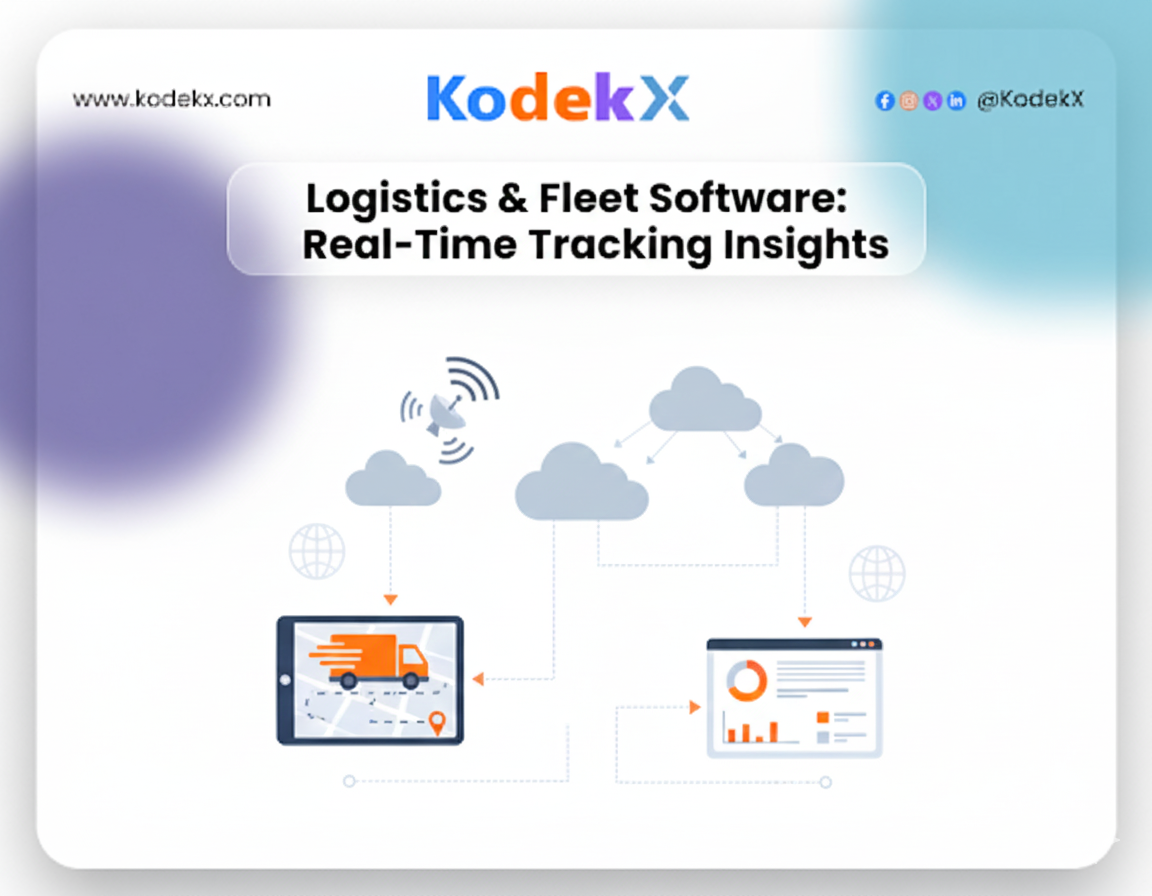
Ever felt like managing your fleet is like juggling blindfolded—vehicles spread across regions, deliveries delayed, fuel costs rising, and customers constantly asking, “Where’s my order?” That uncertainty costs money and credibility. The good news? Logistics and fleet software with real-time tracking flips the script. By giving you full visibility, Predictive analytics in supply chain insights, and smarter automation, it empowers you to optimize every delivery, every vehicle, and every driver.
TL;DR / Quick Answer
Logistics and fleet software with real-time tracking gives businesses full visibility into vehicle locations, routes, and performance. It reduces fuel costs, prevents delays, and improves customer experience through live updates and predictive analytics.
Key Facts
- 92% of logistics companies cite real-time visibility as their top operational priority (2024, Gartner).
- Businesses using GPS-enabled fleet software cut fuel expenses by 15–20% on average (2023, McKinsey).
- 72% of consumers expect accurate delivery ETAs with live updates (2024, PwC).
- Companies adopting AI-driven route optimization report a 28% increase in delivery efficiency (2025, Deloitte).
- Global fleet management software market expected to reach $67.3 billion by 2030, growing 15% annually (2024, Statista).
Why Real-Time Tracking Matters in Fleet and Logistics
In today’s fast-moving supply chain landscape, real-time fleet tracking software has shifted from a “nice-to-have” to a mission-critical logistics technology. It’s not just about putting dots on a map—it’s about building an intelligent logistics ecosystem that scales efficiently, meets customer expectations, and ensures compliance.
Customer Expectations Are Higher Than Ever
Modern consumers are conditioned by platforms like Amazon and Uber, where instant updates and accurate ETAs are standard. According to PwC, 72% of customers expect real-time delivery updates (2024). If your fleet software doesn’t deliver this visibility, you risk losing trust and repeat business.
Operational Efficiency & Cost Reduction
Fuel, vehicle maintenance, and driver overtime remain the largest cost centers for logistics companies. With telematics and GPS tracking software, businesses can minimize wasted miles, reduce idle time, and proactively schedule predictive maintenance.McKinsey reports that fleets using advanced tracking cut fuel expenses by 15–20% on average (2023).
Regulatory & Compliance Needs
Governments worldwide are tightening regulations on emissions, driver hours, and road safety. Many regions now mandate electronic logging devices (ELDs) to monitor compliance. Real-time tracking software with built-in compliance features helps avoid penalties while ensuring safer operations.
Competitive Advantage Through Predictive Insights
Competitors that rely on manual logs or basic GPS risk falling behind. Fleet management software with AI-driven real-time tracking doesn’t just monitor—it predicts. Dynamic route optimization, predictive maintenance alerts, and automated safety notifications create a proactive logistics system. Companies using AI for routing have achieved a 28% improvement in delivery efficiency (2025, Deloitte).
By integrating real-time tracking insights into your fleet operations, you gain the dual advantage of cutting costs and elevating customer satisfaction, while staying ahead of compliance and competition. In short, real-time tracking is the foundation of a future-ready logistics strategy.
Core Features of Logistics & Fleet Software
Modern logistics and fleet software goes far beyond simple GPS tracking—it creates an integrated ecosystem of tools that improve supply chain visibility, driver performance, and operational efficiency. These features help businesses reduce costs, ensure compliance, and deliver superior customer experiences.
Live GPS Tracking
With real-time GPS tracking software, fleet managers can instantly pinpoint vehicle locations and share accurate ETAs with customers. This level of transparency has become a customer expectation—72% of consumers now demand precise delivery updates (2024, PwC). Live tracking also improves dispatching decisions by enabling proactive rerouting during traffic or weather disruptions.
Route Optimization
AI-powered route optimization tools dynamically adjust delivery schedules based on traffic, road closures, or order priorities. Companies adopting advanced routing software have reported a 28% increase in delivery efficiency (2025, Deloitte). Unlike static planning, dynamic rerouting ensures faster deliveries and lower fuel costs.
Telematics & Driver Behavior Monitoring
Fleet telematics systems track critical driver performance metrics such as braking, speeding, idle times, and fuel consumption. UPS, for example, used telematics to save 10 million gallons of fuel annually (2023). These insights help logistics teams encourage safer driving, reduce risks, and cut unnecessary fuel expenses.
Predictive Maintenance
With predictive analytics and IoT sensors, fleet management software can forecast maintenance needs before breakdowns occur. FedEx reduced breakdown-related delays by 22% through predictive maintenance adoption (2024). Preventing unexpected downtime not only saves repair costs but also safeguards delivery commitments.
Integration With Supply Chain Systems
The true power of logistics software lies in its integration with ERP, CRM, and warehouse management systems. This creates a seamless data flow across procurement, inventory, and delivery. For mid-sized retailers, cloud-based ERP development fleet platforms have enabled scaling from 10 to 100 vehicles without losing efficiency (2025).
In essence, these features transform fleet management software into a central hub for logistics automation, compliance, and customer satisfaction—making it an indispensable tool for modern businesses.
Comparative Insights: Fleet Software vs. Traditional Methods
When evaluating fleet management approaches, the contrast between traditional methods and modern logistics & fleet software with real-time tracking is striking. Manual tracking or GPS-only systems can no longer keep up with the demands of scalable logistics operations, where customers expect accuracy, compliance is critical, and operational costs must be tightly managed.
The following comparison highlights how real-time fleet tracking software transforms visibility, cost efficiency, compliance, and customer experience compared to outdated methods.
| Aspect | Traditional Tracking (Manual/GPS-only) | Logistics & Fleet Software (Real-Time) |
|---|---|---|
| Visibility | Limited, delayed updates | Limited, delayed updates Instant, real-time data with GPS & telematics |
| Cost Management | Reactive expense tracking | Predictive cost control with analytics |
| Route Optimization | Static, manual planning | AI-driven, dynamic adjustments |
| Compliance & Safety | Manual logs, prone to errors | Automated ELD integration, safety alerts |
| Customer Experience | Generic delivery windows | Live ETAs & proactive notifications |
Why Traditional Methods Fall Short
Traditional fleet tracking tools often rely on manual data entry or standalone GPS devices. These systems provide delayed updates and lack actionable insights. As a result, logistics teams face higher fuel costs, missed ETAs, and compliance risks.
How Real-Time Software Delivers Value
On the other hand, real-time fleet management software integrates GPS tracking, telematics, and AI-driven optimization. This allows businesses to:
- Provide customers with accurate ETAs and real-time notifications.
- Use predictive maintenance alerts to cut downtime.
- Monitor driver behavior for safety and fuel efficiency.
- Monitor driver behavior for safety and fuel efficiency. Scale operations seamlessly using cloud-based logistics software.
Industry data shows that companies using advanced fleet software reduce fuel costs by up to 20% (2023, McKinsey) and increase delivery efficiency by 28% through AI-based routing (2025, Deloitte).
Common Pitfalls & Fixes
- Relying only on GPS devices → Fix: Choose software with analytics and automation.
- Ignoring driver adoption → Fix: Provide mobile-friendly apps and training.
- Data overload without insights → Fix: Use dashboards with actionable KPIs.
- Underestimating cybersecurity risks → Fix: Deploy encrypted data systems.
- Not scaling with business growth → Fix: Select cloud-native, modular platforms.
- Failing to integrate with existing systems → Fix: Use APIs and middleware for smooth workflows.
Real-World Case Examples
When it comes to logistics and fleet software, real-world applications highlight how real-time tracking insights, predictive analytics, and telematics translate into measurable business outcomes. These case studies show how leading global companies—and even regional businesses—are using fleet management software to drive efficiency, reduce costs, and scale operations.
DHL: Route Optimization at Scale
DHL adopted AI-powered route optimization software to manage seasonal peaks and unpredictable demand. By integrating real-time traffic data and delivery priorities, DHL achieved an 18% reduction in delivery delays and significantly improved customer NPS scores (2024). This example shows how logistics software with dynamic routing directly impacts customer satisfaction while lowering operational stress.
UPS: Telematics for Fuel Efficiency
UPS deployed fleet telematics solutions across its North American operations to monitor idle times, braking patterns, and driver efficiency. The initiative reduced fuel consumption by over 10 million gallons annually, saving nearly $300 million (2023). This case highlights how logistics and fleet tracking software can drastically cut costs and improve sustainability in large-scale operations.
FedEx: Predictive Maintenance Success
FedEx integrated predictive maintenance tools into its fleet management software. By leveraging IoT sensors and analytics, the company reduced breakdown-related delays by 22% (2024). This demonstrates how fleet SaaS performance monitoring solutions not only ensure timely deliveries but also extend vehicle lifespans and lower repair costs.
Local Retail Chain: Scaling from 10 to 100 Vehicles
A mid-sized retailer in Pakistan embraced a cloud-based fleet management system to expand operations. Within one year, the company scaled from 10 to 100 vehicles while maintaining a 95% on-time delivery rate (2025). This shows how even small and mid-sized businesses can leverage logistics automation and GPS tracking software to scale efficiently without sacrificing service quality.
These examples prove that real-time fleet tracking is not just a technological upgrade—it’s a strategic enabler for both global enterprises and local businesses.
Methodology
This article is based on analysis of industry reports, real-world company case studies, and global market projections.
- Tools Used: Gartner supply chain insights, Deloitte logistics reports, Statista fleet market data.
- Data Sources:
- Process:
- Limitations & Verification:
Actionable Conclusion
Real-time fleet tracking is no longer optional—it’s a competitive requirement. By adopting logistics and fleet software, you’ll cut costs, improve customer trust, and scale without chaos. If you’re serious about transforming your logistics, start by evaluating fleet management platforms that integrate GPS, telematics, and predictive analytics.
Take the next step—download our free Fleet Optimization Checklist and see where your logistics operation stands today.
References
Optimize Your Fleet Today
Real-time tracking that cuts costs and improves delivery performance.
Frequently Asked Questions
Real-time fleet tracking software is a logistics solution that uses GPS, telematics, and IoT sensors to provide live updates on your vehicles’ location, route progress, and operational performance. It continuously collects data from vehicles and displays it on a centralized dashboard, allowing you to monitor delivery status, driver behavior, fuel usage, and estimated arrival times. This level of visibility helps logistics teams make faster decisions, respond to delays, and improve service reliability.
Fleet management software reduces costs by optimizing every part of the logistics process. It analyzes routes in real time to shorten delivery distances, cuts idle time to save fuel, and monitors driving patterns to prevent unnecessary wear and tear. Predictive maintenance features also help avoid costly breakdowns by alerting you before issues arise. Together, these features significantly lower fuel expenses, overtime costs, and repair bills—while improving fleet utilization and profitability.
Absolutely. Logistics and fleet tracking software is not just for large enterprises—cloud-based platforms are designed to scale with your business. Small companies can start with basic tracking features and add advanced capabilities like route optimization, driver monitoring, and automated reporting as they grow. The result is better delivery performance, reduced operational waste, and improved customer satisfaction, even with a small fleet.
Real-time fleet tracking software is used across a wide range of industries that rely on transportation and logistics. E-commerce businesses use it for on-time deliveries, retail companies for inventory distribution, and construction firms for equipment transport. Healthcare logistics companies depend on it for sensitive deliveries, while food delivery and courier services use real-time tracking to improve speed and accuracy. Any sector with vehicles on the road can benefit from the visibility and efficiency it provides.
Yes. Modern real-time fleet tracking platforms prioritize data security through encrypted communication protocols, secure cloud hosting, and strict access controls. Role-based permissions ensure only authorized team members can view or modify data, while compliance with data protection regulations like GDPR keeps sensitive information safe. These security measures protect both your operational data and your customers’ information from potential breaches or misuse.
Real-time fleet tracking improves customer experience by providing accurate delivery ETAs, live order updates, and proactive notifications in case of delays. Customers can track their shipments in real time, which builds trust and reduces support inquiries. Additionally, faster deliveries and fewer missed time windows enhance satisfaction and increase the likelihood of repeat business—making real-time visibility a key driver of customer loyalty.