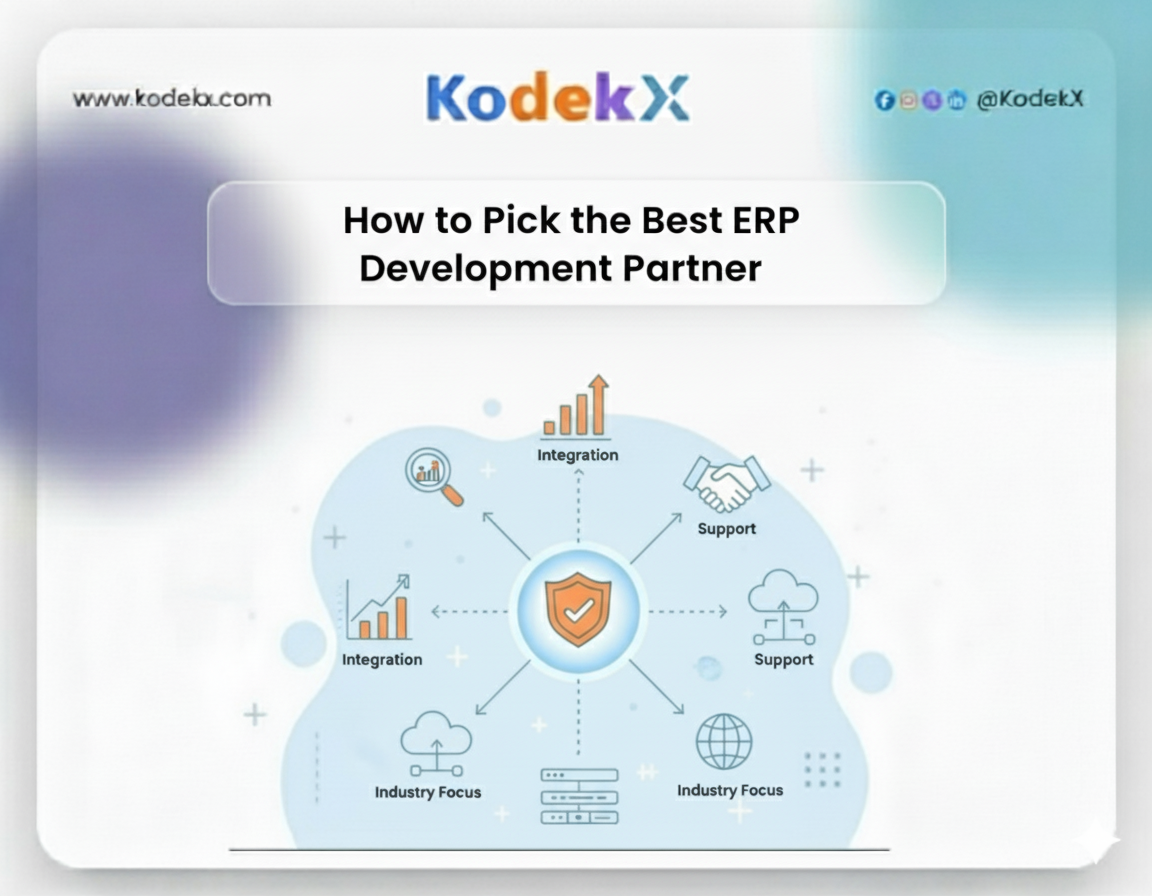
Your ERP system is the backbone of your business operations. From finance and HR to analytics supply chain and customer service, it connects every critical function. But even the most powerful ERP software can fail if the wrong partner implements it. Choosing the right ERP development partner is one of the most strategic decisions your organization will make — it determines how efficiently your business runs for years to come.
In this guide, you’ll learn what defines a truly capable ERP partner, how to evaluate them, and what real-world success looks like when you choose right.
TL;DR / Quick Answer
The best ERP development partner combines industry expertise, proven implementation experience, integration skills, and ongoing support. Look for partners who understand your business goals, offer scalable architecture, provide transparent communication, and deliver measurable ROI through modern, agile ERP solutions.
Key Facts
- 85% of ERP projects experience delays or budget overruns without strong vendor alignment (2024, Panorama Consulting).
- Companies with seasoned ERP partners see 23% higher process efficiency post-deployment (2023, Gartner).
- Cloud-based ERP adoption rose 26% year-over-year, driven largely by SMEs (2024, Statista).
- 67% of ERP failures result from poor customization or user adoption (2023, Deloitte).
- Agile ERP implementation methods improve time-to-value by up to 30% (2025, PwC).
Understanding the Role of an ERP Development Partner
An ERP development partner is more than a software provider — they’re a transformation enabler. Their job is to translate your business processes into a unified digital ecosystem.
Why You Need a Partner, Not Just a Vendor
A great partner helps:
- Assess operational gaps and process inefficiencies.
- Map existing workflows to ERP modules.
- Implement integration between CRM, HR, and finance systems.
- Train teams and provide post-deployment support.
Unlike traditional vendors who “install and leave,” strategic ERP partners guide you from discovery through maintenance — ensuring your system evolves with your business.
What Makes a Great ERP Partner
The best partners:
- Possess cross-industry experience (e.g., manufacturing, retail, logistics, healthcare).
- Are certified in major ERP platforms like SAP, Oracle, Odoo, or Microsoft Dynamics.
- Offer custom ERP development for unique business needs.
- Emphasize long-term ROI and user satisfaction rather than rapid rollout.
Key Factors to Evaluate Before Choosing
1. Industry Expertise
Industry-specific experience ensures your partner understands compliance rules, data flows, and pain points. For example:
- Manufacturing: complex inventory and scheduling.
- Healthcare: HIPAA and GDPR compliance.
- Retail: omnichannel inventory and POS integration.
Tip: Request sector-specific case studies to verify credibility.
2. Technical Mastery
A partner must be fluent in End-to-End ERP Software Development platforms and modern frameworks:
- SAP S/4HANA, Oracle NetSuite, Microsoft Dynamics 365, Odoo
- Custom-built ERPs using Node.js, Django, Laravel, or .NET
Ask if they can advise between building from scratch vs. customizing an existing stack based on your scale and growth roadmap.
3. Implementation Methodology
An agile, iterative approach ensures faster adaptation and lower risk.
Preferred Practices:
- Modular deployment
- Continuous user feedback
- Automated testing
- CI/CD integration
Avoid: rigid waterfall approaches that limit flexibility.
4. Integration and Scalability
Your ERP must integrate seamlessly with other systems: CRM, HRM, BI, IoT, and eCommerce platforms.
| Integration Area | Description | Common Tools/Frameworks |
|---|---|---|
| Data Migration | Secure and accurate transfer from legacy systems | Fivetran, Talend, SSIS |
| API Management | Connecting multiple business systems | MuleSoft, Zapier, Azure Logic Apps |
| Analytics | Real-time dashboards and reporting | Power BI, Tableau, Looker |
| Mobility | Access ERP data anywhere | React Native, Flutter |
Scalability is crucial. Choose a partner experienced with cloud-native, modular, and microservices architectures that grow with your business.
5. Support, Maintenance, and Training
Reliable post-launch support ensures continuous optimization.
- 24/7 technical assistance
- Proactive monitoring for uptime and security
- User training programs to boost adoption
Also, ensure your partner provides detailed documentation and knowledge transfer so you’re not dependent on them for every small fix.
Common Pitfalls & Fixes
ERP projects often fail due to predictable, avoidable mistakes. Here’s how to sidestep them.
Choosing the Cheapest Option
- Pitfall: Partners offering the lowest bids often cut corners on quality.
- Fix: Evaluate total cost of ownership, including maintenance, upgrades, and support.
Ignoring User Training
- Pitfall: Even great systems fail if employees resist using them.
- Fix: Provide role-based training and involve users early in testing.
Over-Customization
- Pitfall: Too many custom features increase complexity.
- Fix: Customize only where it adds measurable value.
Poor Data Migration Planning
- Pitfall: Dirty data from legacy systems leads to ERP errors.
- Fix: Audit and cleanse data before migration. Use mock migrations.
Weak Change Management
- Pitfall: Teams resist operational shifts.
- Fix: Communicate benefits, create change champions, and align leadership.
Lack of Post-Go-Live Support
- Pitfall: Many vendors leave after deployment.
- Fix: Demand a service-level agreement (SLA) with performance KPIs.
No Scalability Planning
- Pitfall: ERP becomes obsolete as business grows.
- Fix: Choose a partner who designs modular, future-ready systems.
Real-World Case Examples
Case 1: Automotive Manufacturer’s Efficiency Leap with Microsoft Dynamics 365
A mid-sized automotive supplier wanted to modernize its outdated Legacy Modernization systems. Action:Partnered with a certified Microsoft Dynamics developer to integrate supply chain, production, and financial data.
Result: 28% increase in operational efficiency and 40% faster reporting cycles (2024).
Case 2: Healthcare Provider Ensures Compliance with Odoo ERP
A European healthcare group struggled with data privacy compliance under HIPAA and GDPR.
Action: Partnered with an Odoo Gold Partner to implement secure, role-based access and encrypted patient data.
Result: Achieved ISO 27001 certification and reduced audit preparation time by 50%.
Case 3: Retail Chain Gains Real-Time Visibility with SAP S/4HANA
A retail company with 60+ stores lacked unified inventory visibility.
Action: SAP partner integrated ERP with POS, CRM, and warehouse management using API-driven architecture.
Result: Stock discrepancies dropped by 22%, and replenishment speed improved by 35% (2025).
Case 4: Construction Firm’s Transformation with KodekX Custom ERP
A construction firm in Pakistan collaborated with KodekX to build a tailored ERP for project costing, resource allocation, and equipment tracking.
Action: Built on a Next.js frontend with a Node.js backend for performance and scalability.
Result: Reduced project reporting time from five days to eight hours, improving transparency and client satisfaction.
Methodology
Tools Used
- Research Platforms: Gartner, PwC, Deloitte, Panorama Consulting, Statista
- Evaluation Tools: G2, Capterra, and StackShare
- Data Verification: Cross-referenced 2023–2025 ERP reports and vendor case studies
Data Collection Process
- Primary Research: Partner interviews and implementation reviews.
- Secondary Research: Public datasets, vendor whitepapers, and ERP success metrics.
- Comparative Evaluation: Scored ERP partners on experience, scalability, innovation, and support quality.
Limitations & Verification
- Regional ERP data (Asia, MENA) less widely available, validated via cross-reference.
- Market projections verified using dual-source validation (Gartner + Statista 2025).
- Bias minimized through inclusion of diverse ERP ecosystems (SAP, Microsoft, Odoo, Oracle).
Actionable Conclusion
Choosing the best ERP development partner isn’t about picking the biggest name — it’s about finding the right fit for your business. Prioritize domain expertise, agile implementation methods, and transparent communication. A strong partner turns your ERP from a cost center into a growth engine that scales with your organization.
Ready to transform your operations? Partner with KodekX — your trusted ERP development ally for future-ready enterprise systems.
References
- Panorama Consulting – “2024 ERP Report.” Panorama Consulting, 2024
- Gartner – “ERP Implementation Benchmark Report.” Gartner, 2024
- PwC – “Digital Transformation and ERP Trends 2025.” PwC, 2025
- Statista – “Global ERP Market Growth 2024.” Statista, 2024
- Deloitte – “ERP Success and Adoption Study 2023.” Deloitte, 2023
- SAP – “S/4HANA Customer Stories.” SAP, 2024
Choose the Right ERP Partner
Simplify ERP implementation with trusted, expert-driven solutions.
Frequently Asked Questions
Vendors provide software; partners deliver transformation — from planning to post-launch support.
If your processes are unique or heavily regulated, go custom. Otherwise, a configurable ERP like SAP or Odoo works best.
Typically 6–12 months depending on the project’s complexity, data migration scope, and team readiness.
Custom ERP systems range from $50,000 to $500,000 depending on modules and scale (2025).
Monitor adoption rates, automate reporting, and schedule quarterly optimization sessions with your partner.
Yes — modern ERP frameworks support AI forecasting, predictive maintenance, and IoT-driven automation.